"Saint Therese of Lisieux and the Sacred Heart of Jesus" by Maureen O'Riordan

On the First Friday of July I am happy to present my new article "Saint Therese of Lisieux and the Sacred Heart of Jesus," which the Apostleship of Prayer has published on its Web site. Therese joined the Apostleship of Prayer on October 15, 1885, when she was twelve.  With St. Francis Xavier, she is now its co-patron. 


Blessed Louis Martin, the "incomparable father" of St. Therese: a Father's Day meditation

Blessed Louis Martin, the "incomparable father" of St. Therese of Lisieux: A Father's Day Meditation


               At the beatification of Louis and Zélie Martin, Cardinal Saraiva Martins, reading the Pope’s letter, described them as “laypersons, spouses, and parents.” Louis, spouse and parent, knew that the first duty of a good father is to be a good husband. Zelie wrote about him, “I am always very happy with him; he fills my life with tenderness and sweetness. My husband is a very holy man; I wish every woman had a husband like him . . . Our feelings were always in unison, and he was always my support and my consolation.” In the years of their marriage (1858-1877), Louis was a most generous husband and father. Seeing the success of Zélie’s lace business, he gave up the craft of watchmaking for which he had trained for many years, sold his business to his nephew for a modest price, and handled the traveling and business end of the lace-manufacturing business. After Zélie’s death, he left his friends in Alencon to give his daughters the advantage of the influence of their maternal uncle, aunt, and cousins at Lisieux. At a time when the father was usually “master of the house,” he gave his older daughters a free hand in running the household and teaching their little sisters. He spared nothing to develop their talents, procuring art lessons and supplies and giving them every advantage in his power.


Louis Martin was a brave man. As a boy, he belonged to a boys’ military club. Exercising regularly, he grew into a tall, vigorous man. He swam well enough to save a child from drowning, saved trapped persons from fires, and was so courageous on the streets that, if he was out later than usual, his daughters worried that he might be badly injured while trying to separate men who were fighting.


His feminine side was well developed. When he was left a single parent, he became both father and mother to his daughters, who said “our father’s affectionate heart was enriched with a truly maternal love.” Many days he escorted the girls to and from school, listening patiently to the accounts of their days. Every evening he joined them after supper in their little salon, making toys for them, singing to them, telling them stories, reciting poems, and playing games before family prayers.


He had a profound respect for the spiritual lives of his daughters; he not only gave them the greatest freedom to fulfill their vocations but actively supported them. When the vicar-general of the diocese failed to support Therese when she appealed to the Pope for permission to become a Carmelite at fifteen, Louis, meeting him several days later, said forthrightly: “You know very well that you had promised to help me.” When the family was visiting Alencon and Leonie abruptly and without asking permission entered the Poor Clares, he permitted her to remain there and supported her generously. He understood that his daughters belonged to God, Who entrusted him with their care, and joined generously with his wife in their joint task “to bring them up for heaven.” When he became paralyzed and had to accept being cared for in an institution and then by his family, he surrendered himself completely and was deeply touched by their devotion.


Blessed Louis Martin offers the fathers of today a new model of masculinity and fatherhood. Uniting his love for God with his love for his wife and his daughters, he understood the essence of fatherhood: that his role as co-creator of the souls of his children to glorify God did not end with their birth, but continued throughout his life. He was a father, as he often repeated, “all for God’s greater glory.”


St. Therese of Lisieux and the Sacred Heart of Jesus

On the vigil of the Feast of the Sacred Heart in 2009, I am happy to present the poem "To the Sacred Heart of Jesus." Therese wrote this poem either in June 1895 or in October 1895 at the request of her sister, Marie of the Sacred Heart. She does not understand the Heart of Jesus as demanding reparation, but as "burning with tenderness." In her daring climax, she chooses that Heart for her purgatory.


“To the Sacred Heart of Jesus”


At the holy sepulchre, Mary Magdalene,

Searching for her Jesus, stooped down in tears.

The angels wanted to console her sorrow,

But nothing could calm her grief.

Bright angels, it was not you

Whom this fervent soul came searching for.

She wanted to see the Lord of the Angels,

To take him in her arms, to carry him far away.


Close by the tomb, the last one to stay,

She had come well before dawn.

Her God also came, veiling his light.

Mary could not vanquish him in love!

Showing her at first his Blessed Face,

Soon just one word sprang from his Heart,

Whispering the sweet name of: Mary,

Jesus gave her back her peace, her happinesss.


O my God, one day, like Mary Magdalene,

I wanted to see you and come close to you.

I looked down over the immense plain

Where I sought the Master and King,

And I cried, seeing the pure wave,

The starry azure, the flower, and the bird.

“Bright nature, if I do not see God,

You are nothing to me but a vast tomb.”


I need a heart burning with tenderness

Who will be my support forever,

Who loves everything in me, even my weakness...

And who never leaves me day or night.”

I could find no creature

Who could always love me and never die.

I must have a God who takes on my nature

And becomes my brother and is able to suffer!


You heard me, only Friend whom I love.

To ravish my heart, you became man.

You shed your blood, what a supreme mystery!...

And you still live for me on the Altar.

If I cannot see the brilliance of your Face

Or hear your sweet voice,

O my God, I can live by your grace,

I can rest on your Sacred Heart!


O Heart of Jesus, treasure of tenderness,

You Yourself are my happiness, my only hope.

You who knew how to charm my tender youth,

Stay near me till the last night.

Lord, to you alone I’ve given my life,

And all my desires are well known to you.

It’s in your ever-infinite goodness

That I want to lose myself, O Heart of Jesus!


Ah! I know well all our righteousness

Is worthless in your sight.

To give value to my sacrifices,

I want to cast them into your Divine Heart.

You did not find your angels without blemish.

In the midst of lightning you gave your law!...

I hide myself in your Sacred Heart, Jesus.

I do not fear, my virtue is You!...


To be able to gaze on your glory,

I know we have to pass through fire.

So I, for my purgatory,

Choose your burning love, O heart of my God!

On leaving this life, my exiled soul

Would like to make an act of pure love,

And then, flying away to Heaven, its Homeland,

Enter straightaway into your Heart.


The Poetry of Saint Therese of Lisieux, tr. Donald Kinney, O.C.D. Washington, D.C.: ICS Publications, 1996, pp. 117-120. All rights reserved. Used with permission.

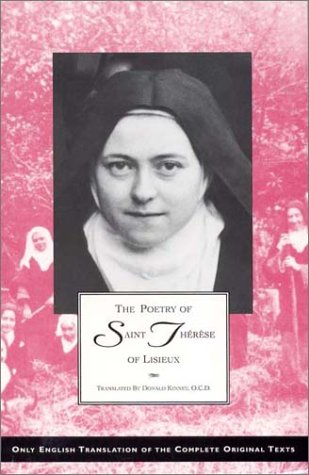
To read this and all of Therese's 54 poems, please order a copy of the book "The Poetry of Saint Therese" by clicking on the icon below. This edition is the only English translation from the critical and complete edition of Therese's manuscripts of her poetry. Even if you have read some other translation, I urge you to read this one, which includes the original French text and English notes rich in interest.
 

A happy birthday to Leonie Martin, sister of St. Therese of Lisieux

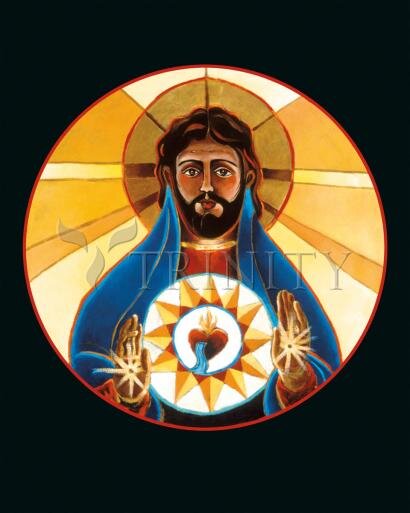
“Sacred Heart” icon by brother mickey mcgrath, OSFS.  Available at trinity stores.

“Sacred Heart” icon by brother mickey mcgrath, OSFS. Available at trinity stores.

Today is the birthday of Leonie Martin, the sister of St. Therese, who was born at Alencon on June 3, 1863.  Leonie was a special-needs child.  When she was a child, Louise Marais, the Martins' maid at Alencon, abused her.  Leonie had a hard time  finding her place in the world, and entered religious life four times before she finally persevered.  She was an early disciple of the "way of confidence and love" of her little sister. 

In October 2008 I visited the Monastery of the Visitation at Caen and saw the door through which Leonie entered definitively on January 28, 1899, declaring "The next time I leave here, it will be in my coffin!"  Sister Francoise-Therese, the community’s archivist, laughingly pointed out the irony that the body of Leonie, whose religious name was also Sister Francoise-Therese, has never left the Visitation because she was buried in the crypt, where I visited her tomb. 

Praying at Leonie's tomb, I received a unique grace.  Unexpectedly, I remembered the times in my life that I'd been deeply hurt, and I felt Leonie, who was treated so badly and yet grew into a loving, generative person, assuring me that the wounds these experiences had left were no obstacle to sanctity.  I understood why so many parents of special children commend them to her, and why so many people who struggle to find a place in life invoke her prayers. 

To learn more about Leonie's life, please see the Leonie’s life” section of this Web site.

When Therese lay dying, Leonie, then 34, had failed three attempts at religious life and was living as a laywoman with her uncle and aunt. On July 17, 1897, in her last letter to Leonie, Therese wrote:

The only happiness on earth is to apply oneself in always finding delightful the lot Jesus is giving us. Your lot is so beautiful, dear little sister; if you want to be a saint, this will be easy for you since at the bottom of your heart the world is nothing to you. You can, then, like us [like her four Carmelite sisters] occupy yourself with "the one thing necessary"; that is to say, while you give yourself up devotedly to exterior works, your purpose is simple: to please Jesus, to unite yourself more intimately with Him. 

You want me to pray in heaven to the Sacred Heart for you.  Be sure that I shall not forget to give Him your messages and to ask all that will be necessary for you to become a great saint.

Leonie was born in the month of the Sacred Heart and died in the same month, on June 16, 1941.  In this month of the Sacred Heart, may she help us understand "the abysses of love and mercy of the Heart of Jesus."


See an online exhibit of 116 photos of Lisieux at the time of Therese

To honor the anniversary of the canonization of St. Therese on May 17, 1925, I am happy to present the link to an online exhibit of 116 photos of Lisieux "au temps de Therese."  The photographer, Francois Bidet, operated a pharmacy near that of Isidore Guerin, Therese's uncle. The exhibit is presented by La Bibliotheque Electronique de Lisieux; the photos are the property of the Musee d'art et de histoire de Lisieux, and the accompanying text was written by Jean Bergeret.  You can see the Cathedral Saint-Pierre on the Place Thiers during the bitterly cold winter of 1895; a man begging who could be one of the people helped by the Martin family; a Eucharistic procession in the town square; market day, and many other photos.

See two new online films about the life of Blessed Louis and Zelie Martin and the family of St. Therese in Alencon

"Louis and Zelie Martin of Alencon" shows scenes familiar to the Martin family in Alencon, interviews in French, and the first film footage of the Pavilion, Blessed Louis Martin's watchtower and walled garden on the outskirts of Alencon.  Until the beatification of Zelie and Louis in October 2008, this property had been closed to pilgrims for decades. 

"The Inauguration of the Martin Family Home in Alencon" films the event in late April 2009 at which Louis and Zelie Martin's house on Rue Saint-Blaise, where St. Therese was born, was reopened to the press after having been closed for restoration.  Most of the film is interviews in French with Mgr. Jean-Claude Boulanger, bishop of Seez, and artists who worked on the restoration.  I thank the diocese of Seez WebTV for permission to post the films. 

St. Therese of Lisieux and the Apostleship of Prayer

    The archives of the Carmel of Lisieux conserved a document signed by Therese Martin at the age of 12, showing that on October 15, 1885 she enrolled in the Apostleship of Prayer, an association born of the missionary desires of Jesuits at a French seminary in 1844.  St. Therese of Lisieux is now co-patron of the Apostleship of Prayer.  Learn more about the Apostleship of Prayer and Therese's relationship with it.

February 25, 2009 is the fiftieth anniversary of the death of St. Therese's last surviving sister

February 25, 2009 marks fifty years since Sister Genevieve of the Holy Face and Saint Therese, the last surviving sister of St. Therese of Lisieux, died in the Carmel of Lisieux on February 25, 1959.  Born Marie Celine Martin, she lived at home with St. Therese until Therese entered Lisieux Carmel on April 9, 1888.  For more than six years, while Celine lived as a laywoman and looked after their father, who was ill, the sisters were separated.  After the death of Blessed Louis Martin, Celine entered the Carmel on September 14, 1894.  As a novice she learned her sister's "way of confidence and love," of which she was a tireless apostle all her life.  She made the offering of herself to Merciful Love with St. Therese on June 11, 1895, and she was the first person to read the childhood memories Therese wrote in 1895 (later the first part of "Story of a Soul").  She looked after St. Therese during her illness.  She painted a famous image of the Holy Face of Jesus and many other portraits, especially of her sister.  She testified at the processes for Therese's beatification and canonization and at the diocesan processes for the cause of her mother and her father, Blessed Zelie and Louis Martin.

For significant dates in Sister Genevieve's life, please see (thanks to Internet Archive) the Web site of the Shrine of Lisieux.

For the powerful correspondence between Therese and Celine, please see  The Letters of St. Therese of Lisieux (Volume I, 1877-1890 and The Letters of St. Therese of Lisieux (Volume II: 1890-1897).

For Celine's memoir of her sister, please see My Sister Saint Therese.

See Celine: Sister and Witness of St. Therese of the Child Jesus, a biography by Franciscan Father Stephane-Joseph Piat, who worked closely with Celine in the 1950s to write the story of her family.

"Pilgrimage to the Beatification of Blessed Zelie and Louis Martin: Alencon and Lisieux, 2008" - a film by Susan Ehlert

With thanks to Susan Ehlert, I am happy to present her seven-minute photo show of the events of the week of the beatification of Louis and Zelie Martin, the parents of St. Therese in October 2008.  Join us as we tour the places Louis and Zelie knew in Alencon.  Glimpse the historic exhibit of the belongings of the Martin family at St. Jacques Church in Lisieux.  See the renovated Carmelite monastery and the souvenirs of St. Therese.  Watch the events of Beatification Sunday.  Visit the garden of the house in Rue Labbey, Lisieux, where Blessed Louis lived for the last two years of his life.  Scroll down a little on the page to find the photo show.

"Exposition: Story of a Family: Louis and Zelie Martin"

One of the highlights of my pilgrimage to Lisieux for the beatification of Zelie and Louis Martin, the parents of Saint Therese of Lisieux, was visiting the "Exposition: Story of a Family: Louis and Zelie Martin" mounted by the Pilgrimage Office at St. Jacques Church in Lisieux.  Hundreds of items from the everyday lives of the Martin and Guerin families were beautifully displayed.  As part of the beatification festivities, costumed guides representing Louis and Zelie Martin and Isidore and Celine Guerin conducted us through the candlelit exhibit on the evening of Thursday, October 16. 

"Death of a mama: August 28, 1877" - newly translated article about the death of Venerable Zelie Martin, mother of St. Therese

The article "Death of a mama: August 28, 1877," newly translated for us from "Therese de Lisieux," the magazine of the Pilgrimage Office at Lisieux, gives details of the last hours, death, and funeral of Venerable Zelie Martin.  It includes the testimony of Louise Marais, who looked after Zelie in her last illness.

A photo album of Lisieux in 1872

Thanks to the Baron de Moidrey and the electronic library at Lisieux, I discovered an album of photos of the town taken in 1872, the year before Therese's birth and five years before Louis Martin and his five daughters moved there.  At http://www.bmlisieux.com/galeries/lisieux01/lis01.htm you may see the appearance in 1872 of the Martins' parish church, St. Jacques; the Cathedral of St. Pierre, where they went to Sunday Mass; the old houses on the Grande-Rue; and the Public Gardens, which Therese crossed on her way home from the Guerins. The town, home to a Carmelite monastery founded thirty-four years earlier, looks very tranquil.  One would not guess that in 1925 Pius XI, receiving the pilgrims from Lisieux who had come to Rome for the canonization of the little girl born in Alencon and brought up in Lisieux, would say "A storm, a deluge of glory has descended on Lisieux." 

http://thereseoflisieux.org

The funeral of Sister Therese of the Child Jesus

October 4 - Therese's funeral day

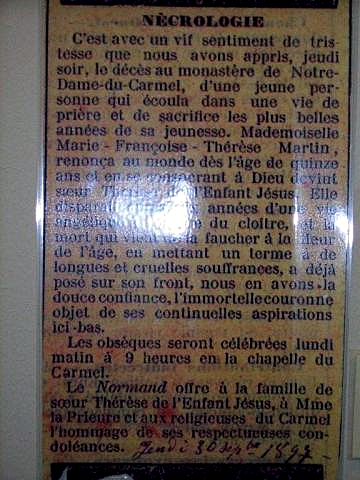
Sister Therese of the Child Jesus died on Thursday evening, September 30, in the infirmary of the Lisieux Carmel. Her funeral took place in the chapel of the Carmel on Monday morning, October 4, at 9:00. Below please see, courtesy of Ana Cantoni, the clipping from the newspaper Le Normand of her death notice:

Lenormandobituary.jpg

An approximate English translation:

Deaths

"It is with a keen feeling of sadness that we learned, Thursday evening, of the death at the monastery of Our Lady of Carmel of a young person who spent the most beautiful years of her youth in a life of prayer and sacrifice.  Miss Marie-Francoise-Therese Martin renounced the world at the age of fifteen.  Consecrating herself to God, she became Sister Therese of the Child Jesus.  She spent years of angelic life in the cloister, and the death which came to end them, by putting a stop to her long and cruel sufferings, has already given her, we have a sweet confidence, the immortal crown which was the object of her continual aspirations here below.

The funeral will be celebrated Monday morning at nine o'clock in the chapel of the Carmel.  Le Normand offers to the family of Sister Therese of the Child Jesus, to the Mother Prioress, and to all the religious of Carmel the homage of its respectful condolences."

After the funeral Mass the body of Sister Therese was taken to the Carmelite plot in the town cemetery, accompanied by a small group of mourners.  Her sister, Leonie Martin, was the chief mourner, for Uncle Isidore was too sick to attend.  The Carmelites were represented by an extern sister.  Leonie testified that the only remarkable thing about the ceremony was the great recollection of the crowd.  Who could have guessed that day that her real death notice, "Story of a Soul," would light up the world; that the tomb would soon be thronged with pilgrims; that, when her body was returned to Carmel in 1923, even before she was beatified, fifty thousand pilgrims would follow her; and that on the hill near the cemetery the basilica of St. Therese would be built?