Preview of the historic Web site of the Archives of the Carmel of Lisieux, January 17, 2011

Carmelitesterrace1901.jpg

 The Archives of the Carmel of Lisieux invite you to the preview of their long-awaited Web site, which was launched today.  This magnificent site, the fruit of years of work, opens to you the doors of the Archives so that you can discover the treasures they contain, to know everything about Thérèse.   To begin to delve into its treasures, please visit

http://www.archives-carmel-lisieux.fr/carmel/

Please note that the opening of the English site, scheduled for March 19, 2012, has been postponed due to the serious illness of the Web designer.  There are 2,000 photos already on the site: photos of Thérèse's family and the places they lived, the Carmelite community, the works of art by the Martin sisters and St. Thérèse, and the works of art she loved.  The site is a marvel of detail and authenticity.   To register for e-mail updates about the English archives, please visit that page.

The site has not yet been migrated to its permanent server, so the connection might be slow, or a page might be unavailable.  The French site will become fully functional at the beginning of next week.  Please return regularly.  As documents are translated into English, more jewels will be added.

We congratulate and thank the Carmel of Lisieux and all the partners who worked with the Archives to accomplish this historic achievement, which makes the treasures of the Archives available to the world.  We thank God that the archives have been digitized, and we ask God's blessing on those who contributed to the accomplishment. Please pray that through this Web site, God may draw souls along the "way of confidence and love" Thérèsewalked in the earthly milieu now visible to all of us.

Update

on 2013-04-18 14:30 by Maureen O'Riordan

The English section of the Web site of the Archives of the Carmel of Lisieux is now open.

"Léonie Martin: A Difficult Life" by Marie Baudoin-Croix. Purchase one of the last new copies available. Shipped from the United States.

Update: February 8, 2014.  "Leonie Martin: A Difficult Life" is now available as an e- book.  Click here to purchase it. 


I am delighted to announce that a fortunate group of readers can purchase new copies of the book Léonie Martin: A Difficult Life, by Marie Baudoin-Croix.  This book about St. Thérèse's sister Léonie, published in French in 1989, was translated into English and published by Veritas Press in Dublin in 1993.  Veritas reprinted it in 2004.  Unfortunately, it is now out of print, and Veritas has announced no plans to reprint it.  But, through a special grace, I have received the last eighty new copies, and you can purchase it through this Web site.

After the August 1, 2011 premiere of the film " Léonie!" in Michigan, I told Cecilia Prizer of Angels of Our Lady Religious Gifts and Bookstore in Phoenixville, Pennsylvania, my partner in distributing books and articles to make St. Thérèse better known, how much I wanted to make the book available to those interested in Léonie.  Through a distributor she found the last new copies of the book, which were in a warehouse in the British Isles.  Now they're in Pennsylvania waiting to be shipped.  To be fair, we are distributing them to the first comers, so please act now if you want one.  $12.95.

   About  Léonie Martin: A Difficult Life

Léonie Martin was the least gifted of the four sisters of St. Thérèse of Lisieux.  She was an emotionally disturbed child, abused by the family’s maid, expelled from school, who suffered and caused anguish in her family.  She did not fit their expectations of holiness.

Marie Baudoin-Croix, the well-known French poet, has examined the letters of Léonie’s mother, Blessed Zélie Martin, to her daughters, her sister, her brother, and her sister-in-law.  We see the backward child, the despair of many, who was the first to follow Thérèse’s Little Way.  The author examines Léonie ‘s correspondence with Thérèse, who shared the way generously with her sister.  It was only after three valiant but unsuccessful attempts that Léonie, at the age of thirty-five, was finally accepted by the Monastery of the Visitation at Caen.  She succeeded in conquering a “tough” temperament, so that by the time of her death in 1941, at the age of seventy-eight, she was regarded as a saint, and her monastery at Caen was inundated with letters testifying to her posthumous aid. 

In his preface, Fr. Christopher O’Donnell, O. Carm. writes:  “This book by Marie Baudoin-Croix is to be strongly welcomed.  It does not add to what has been available about Léonie to specialist scholars, but it will be a revelation to so many admirers of St. Thérèse in the English-speaking world . . . . It is an ideal companion to the autobiography of St. Thérèse.”

In her introduction the author notes: “Quite simply, it is comforting to everyone to know about one woman’s struggle to conquer a difficult, intractable temperament.  Also, the story of the young rebel who was Léonie can give help and hope to parents who are hurt by their clashes—often violent—with their children.”

Léonie’s story can encourage all people, and it inspires especially the parents of other “special needs” children; persons who have a hard time finding a place in society and in the Church; and persons deeply wounded by past experiences.  Paperback, 128 pages, including six pages of photographs.  [Note; these copies sold out in weeks, but, to purchase a used copy online, click on the image above or click here].


A four-minute film of Les Buissonnets, the family home of St. Therese in Lisieux

The Shrine at Lisieux produced a lovely four-minute video and photo show of Les Buissonnets, the little villa at Lisieux where the Martin family lived from their arrival at Lisieux in 1877 until Louis Martin was interned in the Bon Sauveur hospital at Caen in 1889.

les buissonnets, maison familiale de sainte...by sanctuaire_lisieux

An English translation of the life of Léonie Martin written by the nuns of the Monastery of the Visitation at Caen

When Léonie Martin, Sister Françoise-Thérèse, the sister of Saint Thérèse of Lisieux, died in 1941, her life was written by the nuns of the Monastery of the Visitation at Caen and circulated to other monasteries.  Thanks to the great generosity of the nuns of the Monastery of the Visitation at Caen, who gave me permission to publish an English translation of this document at "Saint Therese of Lisieux: A Gateway," and to the partnership of Juan Marrero, who translated the document into English for this Web site, I am happy to announce the publication of this "summary of the life"of  Léonie Martin in English as the centerpiece of a new section of this Web site dedicated to Léonie. I am opening this section on August 1, 2011 in honor of the premiere in Michigan on that day of the American feature film "Leonie!" 

Léonie was one of the earliest and most fervent disciples of Thérèse's way of confidence and love.

I hope that many who see the film, and many others, will want to learn more about the real Léonie Martin


Our Lady of Mount Carmel and the family of St. Therese of Lisieux

For the feast of Our Lady of Mount Carmel I share with you a photograph of the statue of Our Lady of Mount Carmel which was in St. Jacques Church in Lisieux when the Martin family lived there. 

OLMC.jpg

St. Jacques was the parish in which their home, Les Buissonets, was located.  Father Delatroette, who was the ecclesiastical superior of the Lisieux Carmel and opposed Therese's entrance, thinking her too young, was a priest of St. Jacques and, for a time, was Leonie's confessor.  

But when Louis Martin and his five daughters moved to Lisieux in 1877, it was impossible to "rent" seats for six at St. Jacques.  So on Sundays the Martins attended the Cathedral of St. Pierre, where Louis's brother-in-law, Isidore Guerin, was one of the churchwardens.  But the family often participated in weekday Mass at St. Jacques.

It was before this statue in St. Jacques Church that Pauline Martin, Therese's sister, then twenty years old, was praying on February 16, 1882 when she suddenly understood that she was called to become a Carmelite.  Before that she had been thinking of the Visitation, where she had been educated.

St. Jacques Church was substantially destroyed when Lisieux was bombed in 1944, but this statue was recovered.  Although the church was restored after the war, it is no longer used as a church, but serves the town of Lisieux as a municipal exhibit hall, where, in the summer, an exhibit about the Martin family is usually held.  This statue of Our Lady of Mount Carmel can be seen today at St. Pierre's Cathedral.  I thank the photographer, Corinne May, for permission to display her photograph here.

For the reference, see Therese et Lisieux by Pierre Descouvement and Helmut-Nils Loose. Editions du Cerf, 1991, p. 49.  

Ten ways to promote "A Call to a Deeper Love: The Family Correspondence of the Parents of St. Therese of Lisieux, 1863-1885"

 Click on the image to order the book

Ten ways to promote A Call to a Deeper Love: The Family Correspondence of the Parents of St. Therese of Lisieux, 1863-1885

  1. Order the book, which is the letters of Blessed Louis and Zelie Martin.
  2. Submit this writeup to the media.
  3. Download this 8 1/2 x 11 flyer and this 8 1/2 x 14 poster.  Circulate them to your network by e-mail.  Print them out and post them or distribute them in your parish and your community.
  4. Insert this brief blurb in your parish bulletin or your group's newsletter.  Add it to your Web site or Facebook page.
  5. Add "www.thereseoflisieux.org" to your e-mail signature.  Link to it online.
  6. Ask your local bookstore to stock the book.
  7. Request your library to purchase it.
  8. Recommend the book to your friends.
  9. Choose it as a gift for someone who will enjoy it.
  10. Donate a copy to your church library.


The letters of Blessed Zélie and Louis Martin, the parents of St. Thérèse of Lisieux, are now available in English!

$29.95.  Paperback, 464 pages. 

Click on the image to order.

      Welcome to the world of Blessed Louis and Zélie Martin of Alençon, the parents of St. Thérèse of the Child Jesus of the Holy Face.  In these 219 letters, Zélie, writing between the ages of 31 and 45, writes the story of the family that gave birth to Story of a Soul, the memoir of her daughter, the saint.  Here Zélie shares herself unreservedly: happy as a wife and mother, overwhelmed with responsibility as a business owner, saddened by the deaths of her parents and four of her children, sensitive to slights and indifference, concerned for her surviving daughters, longing to become holy.  When she is diagnosed with breast cancer, in the midst of a very human desire to live, she shows us how to abandon ourselves to God in the face of death.

     Only 16 letters from her husband survive, but Zélie introduces us to the younger Louis Martin in the years before he suffered from Alzheimer's disease, was interned in a psychiatric hospital, and died.  We see him here as never before as husband, father, and friend in the years before his martyrdom.

     In beatifying Zélie and Louis in 2008, the Church recognized a fundamental reality: that each one experienced severe traumas, but the effects of these traumas were no obstacle to sanctity.  Louis and Zélie accepted their own powerlessness, that God might be all-powerful in their lives.  The transforming influence of their daughter Thérèse on human history was the fruit of that acceptance.  Reading about their profound love for each other and for their children and the deep faith they lived painfully in the midst of many ordeals is a source of liberation and healing.  Zélie and Louis offer us a personal experience of the motherhood and fatherhood of God.  The book is a mirror of the human face of holiness. 

     A Call to a Deeper Love is a translation of Correspondance familiale, the definitive edition of these letters published in French by Editions du Cerf in 2004.  The preface, the notes, and the presentation are the work of Bishop Guy Gaucher, O.C.D., retired auxiliary bishop of Bayeux and Lisieux and distinguished scholar of St. Therese, and of the Carmelites of Lisieux.  The text is exquisitely translated by Ann Hess.  Dr. Frances Renda added jewels unique to this English edition, including an introduction that reflects her intimate and delicate understanding of the depths of the marital spirituality of Louis and Zélie; background on 19th-century France that helps the reader put these letters in context; a chronology of Thérèse’s family that will be a classic reference; and many new and expanded footnotes. 

     In Story of a Soul Thérèse wrote a new chapter in the history of the human response to divine love.  Before that, Zélie and Louis wrote with their lives a new chapter in the history of marriage: the extraordinary response of two spouses to the call to create a family that was a crucible of sainthood.  A Call to a Deeper Love offers a unique understanding of a couple who became holy in and through their marriage, and it immeasurably deepens our understanding of the influences that surrounded St. Thérèse.  Order your copy now, and may this story of grace and steadfast faith fill you with inspiration, hope, and joy.

$29.95.  Paperback, 464 pages.  

Blessed Louis and Zelie Martin: a Photo Gallery of Their Lives and Beatification

This photo gallery of Louis and Zelie Martin includes many previously unpublished photographs of their environment at Alencon and Lisieux, their family, the ceremony of their beatification, and their reliquary.  These photographs are among those which appear in my photo show "Blessed Louis and Zelie Martin: Their lives and beatification," but I have been asked to display the photos here so that you can examine them at leisure.  I thank the photographers, Susan Ehlert, Ann Hess, and Juan Marrera.  Special thanks to the Pilgrimage Office at Lisieux for permission to display the photographs of their historic 2008 exhibit of objects, photos, and documents associated with the Martin family.  I am happy to offer these photographs in honor of the Feast of All Saints.

125 years ago today, St. Therese of Lisieux . . .

became a member of the Apostleship of Prayer.  The young girl of twelve who joined the Apostleship on October 15, 1885 was declared its patron, together with St. Francis Xavier, in 2004.  For more about Therese's membership and about the Apostleship of Prayer, please see "St. Therese of Lisieux and the Apostleship of Prayer." 


A photo album of those who knew St. Therese at Lisieux

As a special gift for the feast of St. Therese, I have created this photo album of those who knew her at Lisieux.  These photos of the Guerin family and their relatives; priests who knew Therese; her tutor, Mme. Papinau; and others who knew Therese at Lisieux were displayed at an exposition at St. Jacques Church (now a municipal exhibit hall) in Lisieux in 2009.  I am most grateful to the photographers, Peter and Liane Klostermann, for the gift of these photos, and to the Pilgrimage Office at Lisieux for permitting me to display them here. 


The obituary notice of St. Therese of Lisieux -- day nine of the "novena of gifts"

On the anniversary of St. Therese's death, see documents about St. Therese's death and funeral:

  • a photograph of the autograph letter her sister Pauline, Mother Agnes of Jesus, wrote to their sister Leonie and their aunt and uncle, Celine and Isidore Guerin, to tell them of Therese's death
  • the obituary announcing the death of Sister Therese that appeared in "Le Normand," a local newspaper to which her uncle contributed
  • the invitation sent by the Carmelite nuns to Sister Therese's funeral
  • the invitation to Sister Therese's funeral sent by the members of her family

I thank photographer Susan Ehlert for permitting me to display her photos.


Novena of gifts for the feast of St. Therese of Lisieux - day four - contemporary photographs of the countryside around Lisieux

The photographer of the blog "l'instantane normandie" has graciously permitted me to display 72 of his beautiful photographs of the countryside around Lisieux, little changed since the day of St. Therese.  Many of the scenes he has photographed are places the Martin family would have included in their family walks, picnics, and fishing trips.  Please see them here.

Novena of gifts for the feast of Saint Therese of Lisieux - day three - Exhibit of photographs of Lisieux at the time of Therese

As today's gift to prepare for Therese's feast, I invite you to visit an online exhibit of 116 photos of Lisieux "au temps de Therese."  These photos are from the album of Francois Bidet, who was proprietor of a pharmacy near that of Isidore Guerin, Therese's uncle. I thank La Bibliotheque Electronique de Lisieux for mounting this exhibit.  The photos are the property of the Musee d'art et de histoire de Lisieux.  Jean Bergeret wrote the accompanying text.  You can see townspeople shoveling snow before the Cathedral Saint-Pierre on the Place Thiers during the bitterly cold winter of 1895; a man begging who could be one of the people helped by the Martin family; a Eucharistic procession in the town square; market day, and many other photos.  Please visit them at this site.

St. Therese of Lisieux - the hundredth anniversary of the first exhumation of her body on September 6, 1910

Today is the centenary of the first exhumation of the relics of St. Therese of Lisieux.  On September 6, 1910 the body of Sister Therese of the Child Jesus was exhumed from her grave in the Carmelite plot at the municipal cemetery at Lisieux for the first time. Therese had been buried here on the morning of October 4, 1897 after a funeral Mass at Lisieux Carmel.  A small funeral procession followed her body to the cemetery that day.  Her sister Leonie led them, since her uncle, Isidore Guerin, was ill.  Isidore had recently bought this plot in the town cemetery for the use of the Carmelite nuns, and his niece Therese was the first to be buried there. 

It was to this grave that the first pilgrims came, many to give thanks for favors and cures received from God through the intercession of Sister Therese.  Some miracles took place at the tomb.  On May 25, 1908, the mother of little Reine Fauquet, a four-year-old girl from Lisieux who was blind, brought her child to Therese's tomb.  The next day the child's vision was suddenly restored.  Dr. La Neele, Therese's cousin  by marriage, who did not favor the introduction of her cause, nevertheless had to sign a certificate attesting to the cure.  (See Therese and Lisieux by Pierre Descouvement and Helmut-Nils Loose.  Toronto, Ontario: Novalis, 1996, p. 316). 

Lemonniertomb1_edited.jpg

Bishop Lemonnier of Bayeux prays with the Archbishop of Paris at Therese's grave.

Though Therese had died less than thirteen years before, the process to inquire into her sanctity was already underway.  The tribunal convened by the bishop of the diocese of Bayeux had begun in August 1910 to interview witnesses at Lisieux.

The custom of exhuming the body of a person who might be declared a saint was rooted in the time when the Church considered, among other criteria, whether the body of the candidate had been preserved. Because the Church has found that incorruptibility may be caused by environmental conditions, exhumation is no longer necessary.For more about this question see, thanks to Internet Archive, the article by Dwight Longenecker.

The night before Therese's exhumation, she appeared to Mother Carmela of the Heart of Jesus, the prioress of the Carmel of Gallipoli in Italy.  Mother Carmela was not aware that the body of Therese was to be exhumed in France the next day.  She reported that Therese's "countenance was very beautiful and shining, her garments glittered with a light as of transparent silver."  Therese said to her "Only my bones will be found."  (See Storm of Glory: The Story of St. Therese of Lisieux, by John Beevers.  New York: Doubleday, 1955, p. 128).  [For an account of the miracles God worked through Therese in 1910 and 1911 to rescue the Carmel of Gallipoli from near bankruptcy, please see "The Miracle of Gallipoli" by Giovanni Ricciardi.  This miracle confirmed her little way and was given a special session in the diocesan process]. 

The exhumation of Sister Therese's body took place in the presence of Bishop Lemonnier, the bishop of Bayeux,  and of about a hundred other people.  Dr. de Corniere and Dr. La Neele, who looked after Therese in her illness, were present and confirmed that her body had disintegrated in the usual way soon after her death.   Therese had said "You will not find me anything but a little skeleton."  Her sister Pauline recorded that on August 20, 1897, Therese had said to her, "with a happy and mischievious air:  'I shall soon be in the horrors of the tomb!  And you will be there also, little Mother!  And when I see you arrive next to me, my humbled bones will leap with gladness!'  (See St. Therese of Lisieux: Her Last Conversations.  Washington, D.C.: ICS Publications, 1977, p. 156).

1910exhumation2_edited.jpg

The first exhumation of the body of the Servant of God, Sister Therese of the Child Jesus of the Holy Face, at the Lisieux cemetery on September 6, 1910

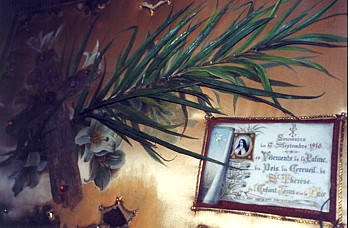
Only the bones covered with bits of cloth remained.  But the palm branch that had been placed inside when she was buried was still fresh and green, as it is today.  Was this God's way of confirming that God had granted Therese's desire to win "the palm of martyrdom"?  "that thus I may become a martyr of Your love, O my God!" 

palma.jpg

Souvenirs of the first exhumation: the palm branch; bits of the coffin

Pauline wrote that on July 3, 1897 she said to Therese:  "When you are dead, they will place a palm in your hand."  Therese answered, "Yes, but I'll have to let it go whenever I want to, in order to give graces by the handful to my little Mother.  I will have to do everything that will be pleasing to me."  (See Last Conversations, p. 72). 

 The gravediggers noticed the scent of violets that came from the rotting boards of the decaying casket. (Therese and Lisieux, p. 310).  Dwight Longenecker mentions the remarks of one of the witnesses to the exhumation about this scent.

firsttombtoday3.jpg

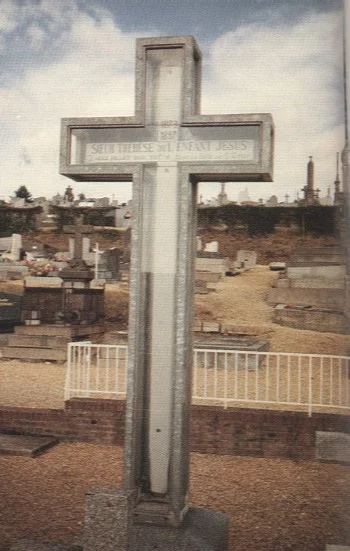
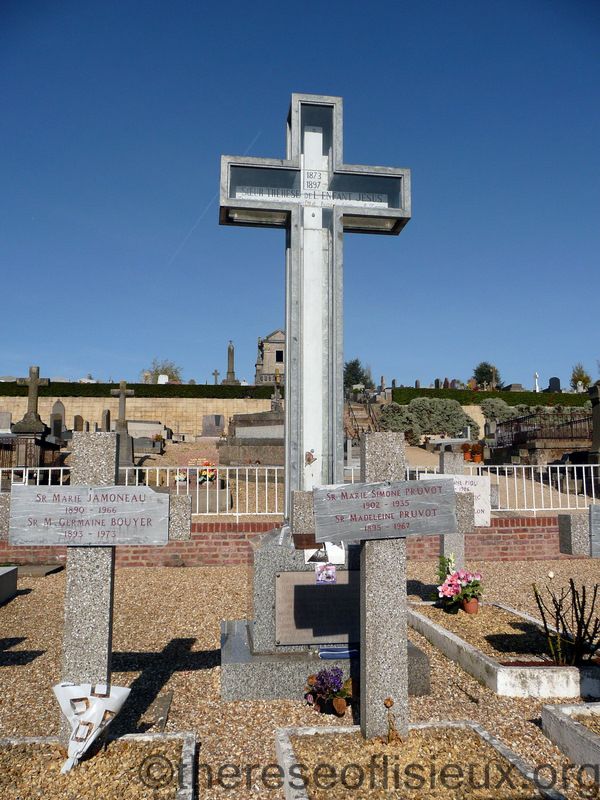
Today the same cross, now enclosed in stone and glass,  that marked Therese's first grave from 1897 through 1910 marks the site where that first grave was.  The statue nearby marks the site of her second grave.Part of the Carmelite plot in the town cemetery. The cross marks the site of Therese's first grave (1897-1910); the statue marks her second grave (1910-1923).

firsttombtoday2.jpg

The cross has the words "I want to spend my heaven in doing good on earth."

firsttombtoday.jpg

After this first exhumation, Therese's body was reburied in a cemented vault in a different burial plot near the center of the Carmelite plot.

secondtombpostcard_edited.jpg

The second grave of Sister Therese of the Child Jesus of the Holy Face (1910-1923).

 As Therese's fame spread, growing numbers of pilgrims came to visit this second grave.

Secondtombpilgrims_edited.jpg

Pilgrims pray at the second grave of St. Therese. Many who had been cured through the intercession of Therese left their crutches and canes there in thanksgiving.

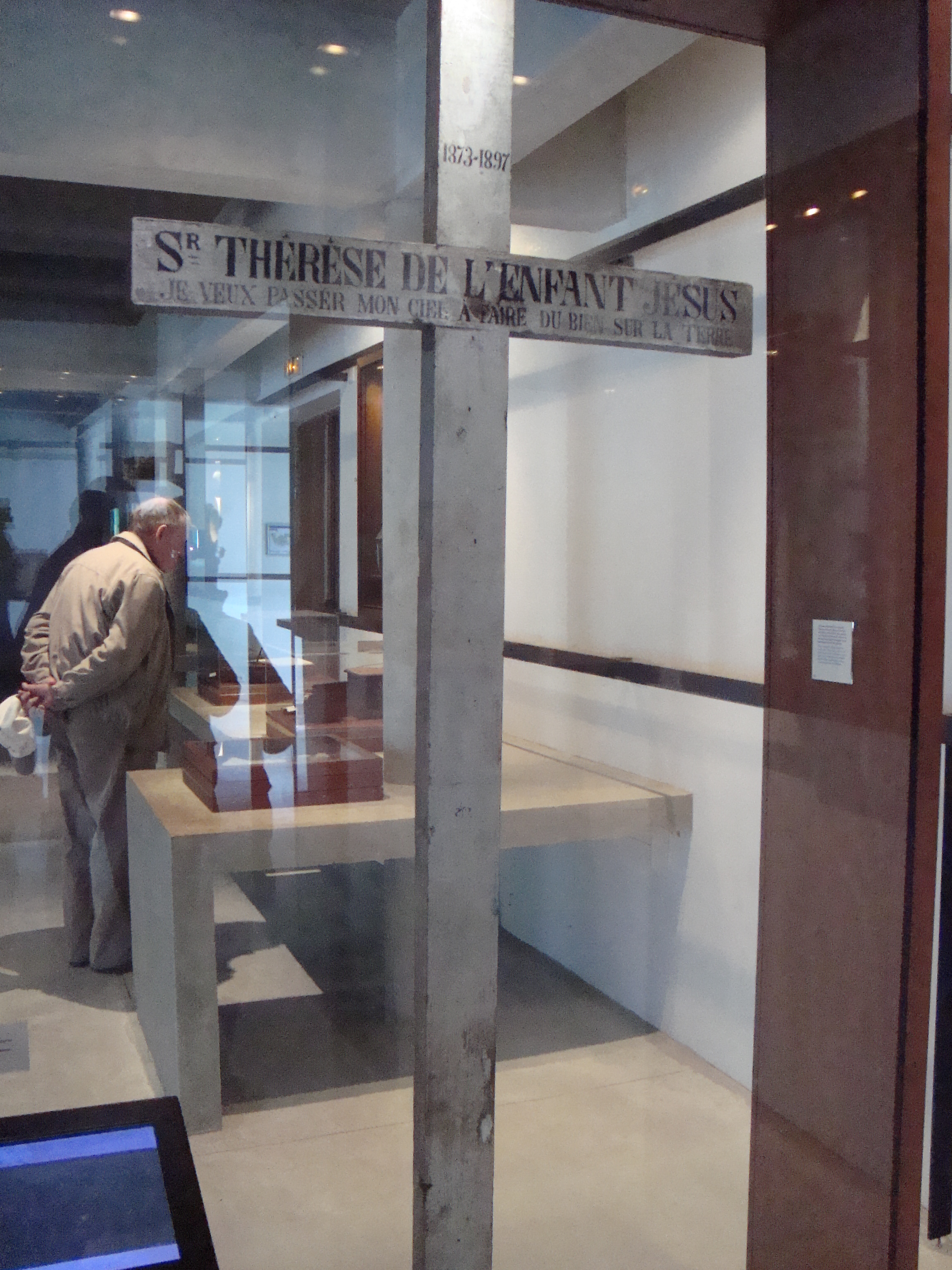
 The cross that marked this second grave is on display today at the "parcours Theresien," a beautiful display of objects associated with Therese at the Lisieux Carmel. 

cardCarmelcross.jpg

A notice from the "parcours Theresien," an exhibit pilgrims may visit at the Lisieux Carmel

fullcross.jpg

On exhibit in the "parcours Theresien" at Lisieux Carmel, the cross that marked Therese's second grave (1910-1923)

closecross.jpg

Pilgrims scribbled their petitions and thanksgivings all over the cross.

Today a statue marks the site of Therese's second grave, where her body remained until it was returned to Carmel on March 26, 1923, a month before she was beatified.

secondtombstatue.jpg

Statue marking the spot in Lisieux cemetery where Therese was buried, 1910-1923

At the base of the statue are written (in French) Therese's words "My God, You have surpassed my expectations, and I want to sing of Your mercies."

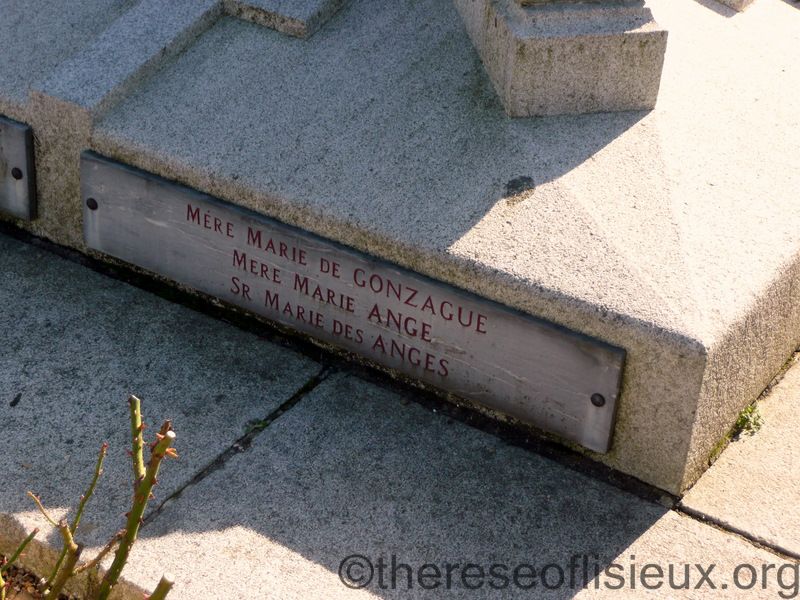
Several other Carmelites are also buried in the plot where Therese's second grave was, including her prioress, Mother Marie de Gonzague; her novice mistress, Sister Marie of the Angels; and Mother Marie-Ange of the Child Jesus, who entered Lisieux Carmel after Therese's death.  Profoundly convinced of Therese's sanctity, she petitioned Bishop Lemonnier on the very day of her election as prioress in 1908 to open the cause of Therese, and he granted her petition.

Carmelitestomb.jpg

Plate bearing the names of three nuns buried in the same plot: Mother Marie de Gonzague, Therese's prioress; Sister Marie of the Angels, Therese's novice mistress; and Mother Marie-Ange of the Child Jesus, a prioress who entered after Therese's death

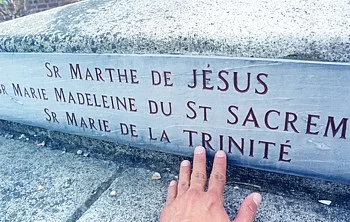
Three of Therese's novices, Sister Martha of Jesus, Sister Marie-Madeleine of the Blessed Sacrament, and Sister Marie of the Trinity, are also buried here.

novices.jpg

Mme. Tifenne, a friend of the Martin family from Alencon and the godmother of Therese's sister Leonie, maintained that this statue resembled Therese more than any other. (See Collected Little Flower Works by Rev. Albert Dolan.  Chicago: Carmelite Press, 1929, p. 160.

secondtombtoday.jpg

Statue marking the site of Therese's second grave in the plot her uncle bought in the town cemetery for the Carmelites

As we pass through the years leading up to the centenary of Therese's canonization, we will celebrate the centenary of many important events, including the close of the diocesan process, the opening of the cause at Rome, the Apostolic Process, the second exhumation, the declaration of Pope Benedict XV that Therese practiced heroic virtue (on which occasion he delivered a long proclamation recommending her way of confidence and love to the whole Church), the solemn translation of Therese's relics to the Carmel, her beatification, and her canonization.  May they be occasions of grace for the whole world.

For permission to use photos I thank the late Fr. J. Linus Ryan and photographers Peter and Liane Klostermann, Juan Marrero, and Jesus Moreno Pacheco.

Meditations on the anniversary of the death of Blessed Louis Martin, father of St. Therese

Blessed Louis Martin, the father of St. Therese of the Child Jesus of the Holy Face, died on Sunday, July 29, 1894 at Chateau La Musse near Evreux.  

A meditation for the anniversary of his death from his niece, Marie Guerin, later Sister Marie of the Eucharist in the Carmel of Lisieux: 

In May 1895, when Marie returned to Chateau La Musse for the first time after her uncle's death, she wrote to her cousin, Louis's daughter Celine:  "I made my little pilgrimage as soon as I had alighted from the carriage.  I have been in my uncle's room, and there all the memories came back to me.  I saw it all again . . . I was overwhelmed with the impression that there, in that chamber, something so great had taken place; that there my uncle had seen God and had been so well received.  It seemed to me that I was also going to see something of Heaven, and my uncle has given me this thought, when thinking of the particular judgement:  "Judge not, and you will not be judged!"

On July 28, 1895, the vigil of the first anniversary of his death, Marie Guerin wrote again:  "I cannot pass by that room without being seized, in spite of myself, with a solemn, calm feeling that speaks to me of the other world and fills my soul.  That happens to me very often and without any preparation on my part.  I am "seized"--it is the correct word to use.  I do not now why but this anniversary, sad in itself, has not at all that effect upon me.  I feel so sure that my uncle entered Heaven that day, that I have rather a feeling of happiness when I think of his deliverance.  How happy he is now, but he has well deserved it . . . !  Tomorrow, I mean to ask many graces from him, and I am sure I shall obtain them on that day.  When one recalls, and has imprinted on one's mind his beautiful expression, calm and full of such happy peace, it is impossible not to be led to love God."  (Story of a Family, by Stephane-Joseph Piat, O.F.M.  New YorK: P. J. Kenedy & Sons, 1947, pp. 417-418).


7 rue Labbey, last home of Blessed Louis Martin, the father of St. Therese of Lisieux

On the vigil of the feast of Blessed Louis and Zelie Martin, a commemorative plaque was dedicated to mark the house at 7 rue Labbey, Lisieux, where Louis lived after he left the Bon Sauveur hospital in Caen in May 1892.  Susan Ehlert and the house's present owners, Mme. Anne-Marie Hervieu and M. Jacques Hervieu, graciously made available photos of the house and plaque and a film of the ceremony, including a view of the garden where Louis spent so much time.  Click here for a virtual visit to rue Labbey.


"Leonie!", a feature film about Leonie Martin, the sister of St. Therese of Lisieux, to be released in the United States in 2010

I am delighted to announce that "Leonie!," a feature film about Leonie Martin, the sister of St. Therese of Lisieux, is scheduled to be released in the United States in the summer of 2010.  The film is being shot in Michigan and at the Visitation Monastery in Toledo, Ohio in July and August 2009.  Barbara Middleton is the executive producer, and Joe Maher wrote the script and is directing the film.  For news stories and a radio show about the film, please see below.

"Big project hits big screen," by Catherine Minolli. The Tri-City Times, July 22, 2009.

"Made in Michigan,"by Matt December.  The Source, July 19, 2009.  Read it online thanks to Internet Archive.

"Local girls land leads in major film shot in Romeo," by Chris Gray.  The Romeo Observer, July 2009.

"Film producers find perfect 'set' in Romeo," by Chris Gray.  The Romeo Observer, July 2009.

 For the life of Leonie Martin, read 

Leonie Martin

Leonie Martin: A Difficult Life. by Marie Baudouin-Croix.  (Click on the image for information).

For a reflection about Leonie Martin, see

"Leonie Martin," a spiritual newsletter of Clairval Abbey, whom I thank for permission to post it here.

For more online information about Leonie's life, see

A feast-day visit to the home of Blessed Louis Martin at 7 rue Labbey, Lisieux

A happy feast to Blessed Zelie and Louis Martin!  As a feast-day gift to my readers, I have created a photo gallery today of my privileged visit, as a pilgrim to their beatification, to the house and garden at 7 rue Labbey where Louis Martin lived with his daughters Leonie and Celine after he was released from the Bon Sauveur psychiatric hospital at Caen.  For the story of this visit and present-day photos of the house at Rue Labbey and of Isidore Guerin's house on Rue-Paul Banaston, please visit the photo gallery for Blessed Louis Martin's home on Rue Labbey.


"Blessed Louis and Zelie Martin, the parents of St. Therese of Lisieux: their lives and beatification," a photo show in honor of their first feast on July 12


Blessed Louis and Zelie Martin, the parents of St. Therese of Lisieux: their lives and beatification from Maureen O'Riordan on Vimeo.


The first liturgical feast of Blessed Zelie and Louis Martin, the parents of St. Therese, will be celebrated on Sunday, July 12, the anniversary of their marriage in 1858. The Shrine at Lisieux has announced a two-day celebration of liturgy, prayer, and festivities.Cardinal Tettamanzi, Archbishop of Milan, will preside at a Pontifical Mass in the Basilica of St. Therese, where Louis and Zelie were beatified on October 19, 2009. See the schedule of liturgies and festivities.

In honor of the first feast of the Martin spouses, I am happy to present the photo show "Blessed Louis and Zelie Martin, the parents of St. Therese of Lisieux: Their lives and beatification" above. Please celebrate the feast by joining us in this virtual pilgrimage to the places Louis and Zelie made holy by living with such faith, hope, and love. View the historic exhibit "Story of a Family" mounted at Lisieux in honor of the beatification, with furniture, possessions, documents, and photos belonging to the Martin family. See photos of Pietro Schiliro, the Italian child healed at the intercession of Zelie and Louis, and photos of his family. View the images of the beatification ceremony and of the reliquary. Come as a pilgrim of the heart to honor the faithful servants of God, and ask for the grace to imitate them.