A sketch of Leonie Martin by Brother Michael O'Neill McGrath, OSFS

With the kind permission of Brother Michael O'Neill McGrath, OSFS, I have the joy of sharing his sketch of Leonie.  As far as I know, it's one of very few artistic representation of Leonie in existence.  I am happy on the feast of St. Francis de Sales to share this homage to Leonie from her Salesian family.

The sketch of Leonie is not yet available for distribution.  Brother Mickey is the author of "Journey with Therese of Lisieux: Celebrating the Artist in Us All.


He has created several beautiful icons of St. Therese and many of other saints.  His work radiates lightness, joy, and playfulness.  Please see his icons at Trinity Religious Artwork and Icons, where they are available for sale.

Bishop Boulanger requests permission to open diocesan process for sainthood of Leonie Martin, sister of St. Therese of Lisieux; French press reports he will announce on January 24, 2015 in Caen

On Saturday, January 24, the feast of St. Francis de Sales, Mgr. Jean-Claude Boulanger, bishop of Bayeux and Lisieux, will announce that he has requested permission to open the diocesan process of beatification for Léonie Martin, the sister of St. Therese of Lisieux, according to stories in the French press.  La Manche Libre, Le Pays d'Auge, Normandie Actuand the French Catholic newspaper La Croix reported the news.  According to these reports, Father Laurent Berthout, the bishop's press officer, said:

“For many years, people have entrusted themselves to the prayers of Léonie Martin, coming to her tomb at the Monastery of the Visitation, where she was a nun from 1899 to 1941. These persons witness to graces they have received through her intercession. Léonie Martin lived a simple, hidden, humble life in the shadow of the cloister. She wanted to live the spirituality of St. Francis de Sales, doing “all through love, nothing through force” in the words of St. Francis. She was blessed by the spiritual discovery of her sister, St. Therese, who taught her to live by Love in the most humble and the most everyday actions. Leonie gave witness by her life to the possibility of living it fully, even through her limitations: character, health, trials.

The French press reports that, when he celebrates Mass tomorrow at the Monastery of the Visitation in Caen, where Leonie was a nun from 1899 to 1941, Bishop Boulanger will announce that he has requested from the Congregation for the Causes of Saints in Rome permission to open the process for Leonie in his diocese.  He has the opinion of the bishops' conference of Normandy, and he is writing a letter to the Congregation asking for this permission.  He will officially confer on Léonie  the title "Servant of God."  Before the process may actually be opened, we must wait for the Congregation to give the "nihil obstat."

The opening of the diocesan process (an inquiry into the life and writings of the candidate for sainthood) is the beginning of a long procedure that, for some candidates, leads ultimately to canonization.  The diocesan process for Therese was opened by an earlier bishop of Bayeux and Lisieux in 1910, and Léonie  testified at it.

"Leonie Martin, A Difficult Life" now available as an e-book

I am delighted to announce that Veritas Press in Ireland has reissued the book "Leonie Martin: A Difficult Life" by Marie Baudoin-Croix, as an e-book.

"Leonie Martin: A Difficult Life," by Marie Baudoin-Croix is in print again!

"Leonie Martin: A Difficult Life," by Marie Baudoin-Croix is in print again!

Many English-speaking readers are familiar with this book from the earlier edition, translated by Mary Frances Mooney, published by Veritas in 1993 and reprinted by them in 2004.  It had been distributed in the United States by Ignatius Press.  I hope very much that it will be reissued in the United States, but, until it is, you can order one from Ireland by clicking on the image above.  Many people have written me asking for copies.  Many interested in Léonie were "special children" or the parents of special children.  Others have had "late vocations" or, like Léonie, have struggled to find a place in a family, in the Church, and in the world.  Of late, as interest in Léonie has increased and used copies became scarce, their price has risen. Seize the opportunity to get a new one.  Do not be put off by the phrase "A Difficult Life," which might seem depressing.  About this 120-page book, from the introduction by Christopher O'Donnell, O. Carm. of the Milltown Institute in Dublin:

The story of Léonie is told by letters, to her and from her, and about her by other members of the family. Hers is a fascinating story, with an interest even independent of her canonised sister.

She tried religious life four times before she was finally professed as a Visitation Sister. There she achieved a high degree of holiness. From a most difficult childhood and adolescence she overcame her disabilities and reached a mature serenity when she finally achieved her goal of being a religious. This book tells of her struggles, her failures, her disappointments, her dogged perseverance. When we get beneath the language and culture of Thérèse, we find that, for all her charm, she was almost ruthless in her pursuit of holiness in her complete sacrifice to God’s merciful love. Léonie too has something of the hard steel that always lies just below the surface in Thérèse. The reader will find Léonie a fascinating person in her own right, very different from her better-known sister.

This book by Marie Baudoin-Croix is to be strongly welcomed. It does not add to what has been available to specialist scholars, but it will be a revelation to so many admirers of St. Thérèse in the English-speaking world. I warmly compliment the author, the translator, and the publishers for making this important book widely available. It is an ideal companion to the autobiography of St. Thérèse. (p. 6)

Click here to order Leonie Martin: A Difficult Life in Kindle format.  If you do not own a Kindle device, Amazon will send you a free Kindle app for your own computer or mobile device.

See a replica of Leonie's cell in the video "The religious life of St. Therese's sister Leonie"

Susan Ehlert's five-minute video "The religious life of St. Therese's sister Leonie" captures a special evening  at St. Jacques Church in Lisieux at which Father Pascal Marie, a chaplain of the pilgrimage, presents a replica of Leonie's cell at the Visitation as part of an exhibit about the Martin family.  Father Pascal is speaking in French, but you can see the cell and the various objects.  Click on "view at Youtube" to read Susan's explanation of what is happening. 

Louis Martin is found at Le Havre, June 27, 1888 (125 years ago with St. Therese)

copy of luigi 65 copia.jpg

From June 23-27, 1888 (125 years ago), a great anxiety came to the family of Blessed Louis Martin.    Louis, whose health had begun to decline, suddenly disappeared from his family home, Les Buissonnets, on Saturday morning, June 23.  His daughters Leonie and Celine, with the maid, searched everywhere for him.  In town, at the pharmacy belonging to his brother-in-law, Isidore Guerin, he had not been seen.  An anxious night followed; Louis was still missing.  On Sunday, June 24, a letter arrived from him (probably addressed to the Guerins, but now lost), sent from the Post Office at Le Havre, asking for some money.  His three daughters in Carmel were finally told of his disappearance, and began to pray fervently.  On Monday the "intrepid Celine" set off for Le Havre, together with her uncle, Isidore Guerin, and his nephew, Ernest Maudelonde.  They planned to search for Louis, but they had no address for him.

 Except for the maid, Leonie was alone at home when, at five o'clock in the morning on Tuesday, June 26, the small house of a neighbor, very close to Les Buissonnets, burned down.  Le Normand, June 26, 1888: 

This morning (Tuesday), shortly before five o'clock, a fire broke out in Lisieux, chemin des Bissonnets [sic], in a little house rented by a M. Prevost, who had left the previous night for Saint-Martin-de-Mailloc after having shut his door; the house, belonging to Madame d'Angot, rue du Bec, was destroyed, as well as the greater part of the furniture. . . . Under the direction of Captain Lepage, two pumps were put in action and extinguished the fire; the first from the hydrant at the City Hall, brought into action by Corporal Lemineux, was able to preserve the house occupied by M. Martin and his family; a piece of wood in the roof was beginning to burn." 

entrancelesbuissonnets.jpg

In July M. Martin bought the burnt property in order ot enlarge Les Buissonnets.  Its site today is occupied by the stairs and the embankment.

Read the letter Mme. Guerin, Louis's sister-in-law, sent later that day to his three Carmelite daughters.  At that time Louis had not yet been found. If you read French, you can also read Mme. Guerin's letter to her husband at Le Havre that same day.

Finally, on Wednesday, June 27, Celine, Isidore, and Ernest found Louis at the Post Office at Le Havre. Although he was lucid, he had become fixated on idea of going away to live in solitude.  They brought him home safe and sound, although he had shaved off his beard. 

[Sources: Letters of Saint Therese of Lisieux, Volume I (1877-1890), tr. John Clarke, O.C.D.  Washington, D.C.: ICS Publications, 1982, p. 439, LD, June 26, 1888 from Celine Guerin to her nieces, footnote 3) and Sainte Therese de Lisieux (1873-1897) by Guy Gaucher, O.C.D.  Paris: Editions du Cerf, 2010, pp. 289-290].

A pilgrimage of volunteers to Caen in the footsteps of Leonie Martin and Blessed Louis Martin, June 24, 2013

volunteersAlenconCaen.jpg

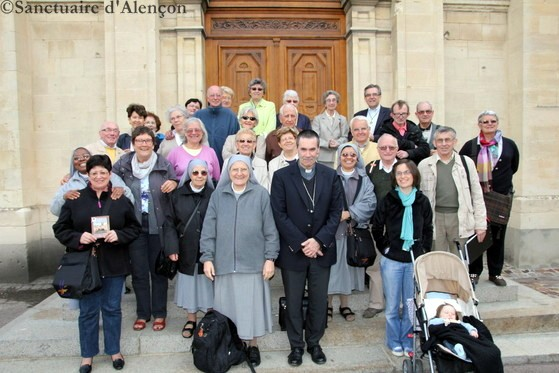
Mgr Habert with volunteers of the Shrine of Alençon outside the chapel of the Visitation at Caen

An historic pilgrimage in the footsteps of Léonie Martin and of her father, Blessed Louis Martin, took place in France today.  The volunteers of the newly organized shrine at Alencon, who welcome pilgrims who want to walk in the footsteps of the Martin family in and near Alencon, in the diocese of Séez, where Louis and Zélie Martin met, married, and spent their married life, and where Thérèse was born, made a pilgrimage as a group to Caen to visit the Monastery of the Visitation, where Léonie Martin lived from 1899 until her death in 1941, and the Bon Sauveur Hospital, where Blessed Louis Martin was confined from February 12, 1889 through May 10, 1892.

mgr-jacques-habert.jpg
FrHenaultMorel.jpg

Mgr Habert, bishop of SeezThey were accompanied by Mgr Jacques Habert, bishop of the diocese of Seéz.  Father Thierry Hénault-Morel in the Visitation chapelFather Thierry Hénault-Morel, the rector of the basilica of Notre-Dame at Alençon, was their guide.

The Shrine at Alençon has already posted 94 photos of the pilgrimage.  Although the captions are still in French, it is a wonderful chance to see photos of the Visitation chapel and  the crypt,  Léonie's souvenirs and her tomb, and almost the first contemporary photos of the interior of the chapel at the Bon Sauveur where Louis Martin worshipped. [I deeply regret that these photos have been removed].

The sudden disappearance of Blessed Louis Martin from Les Buissonnets on June 23, 1888 (125 years ago with St. Therese of Lisieux)

On the morning of Saturday, June 23, 1888, there was panic at Les Buissonnets, the little villa where Blessed Louis Martin, the father of St. Therese of Lisieux, was living with his daughters Celine and Leonie.  Louis had suddenly disappeared without notifying anyone.

copy of luigi 65 copia.jpg

Louis was then sixty-four years old.  This photograph had been taken about three years before. In the months of May and June 1888 he had made several business trips to Paris, where he invested (and lost) 50,000 francs on the Panama Canal.

Louis had recently experienced many losses.  A widower, he had given his second daughter, Pauline, to God as a Carmelite nun in 1882.  In 1886 his oldest daughter, Marie, followed Pauline.  On Monday, April 9, 1888, Louis escorted his youngest, Therese, his "little Queen," to the Carmel.   Six weeks later, on Tuesday, May 22, Marie made her vows.  The next day, on Wednesday, May 23, Louis assisted in the public ceremony at the Carmel chapel in which Marie received the black veil of the professed Carmelite choir nun.  Father Almire Pichon, the Jesuit "spiritual director of the Martin family," preached the sermon.

At this time, despite his losses, Louis was experiencing consolation in prayer.  Therese speaks of his eyes being flooded with tears after he received communion.  Referring to an incident in May 1888, a passage inserted into Story of a Soul by Pauline reads: 

"O Mother, do you remember the day and the visit when he said to us "Children, I returned from Alencon where I received in Notre-Dame Church such great graces, such consolations that I made this prayer:  My God, it is too much! yes, I am too happy. it isn't possible to go to heaven this way!  I want to suffer something for you!  I offer myself . . . . the word 'victim' died on his lips; he didn't dare pronounce it before us, but we had understood."1

Sometime in 1888 Louis sent this note to his Carmelite daughters:

I want to tell you, my dear children, that I have urgent desire to thank God and to make you thank God because I feel that our family, although very humble, has the honor of being among the privileged of our adorable Creator.2

This privilege did not come cheap.  On Friday, June 15, Celine told her father that she also had a vocation to Carmel.  She writes: 

"June 15.  I announced to Papa my vocation for Carmel, and these were the circumstances.  I was showing my dear father a painting I had just completed; he was in the belvedere, seated at his little work table, and he seemed to be meditating.  He turned to me, and he studied my canvas with joy and suggested that he take me to Paris to have me pursue a course in painting.  I immediately answered that I would prefer to give up this art completely rather than expose my soul to any danger, that, having given my heart to Jesus a long time ago, I wanted to keep it pure . . . ." (Sister Genevieve, CMG IV, pp. 183-184).3

Louis readily gave his consent.  "You can all leave.  I will be happy to give you to God before I die.  In my old age, a cell will be enough for me."4  In fact, Celine planned to become a Carmelite only after the death of her father.  Deeply moved, Louis pressed Celine to his heart and said, "Come, let us go together to the Blessed Sacrament to thank the Lord for the graces He has bestowed on our family and for the honor He gave me of choosing His spouses in my home.  Yes, if I possessed anything better,  I would hasten to offer it to Him."5

We leave his family searching for him and the Carmelites praying for his safety.  Please return for the rest of this little adventure, which ends on June 26.  

1Story of a Soul, tr. John Clarke, O.C.D.  Washington, D.C.: ICS Publications, 2005, p. 237.

2A Call to a Deeper Love: The Family Correspondence of the Parents of Saint Therese of the Child Jesus, 1863-1885 Tr. Ann Connors Hess, ed. Dr. Frances Renda.  Staten Island, N.Y.: Society of St. Paul, 2011, p. 365.

3Letters of Saint Therese of Lisieux, Volume I (1877-1890), tr. John Clarke, O.C.D.  Washington, D.C.: ICS Publications, 1982, p. 435 (LT 53, footnote 3). 

4Celine, soeur et temoin de Sainte Therese de l'Enfant Jesus, by Stephane-Joseph Piat.  Office Central de Lisieux, 1964, p. 37 (my translation).

4Story of a Soul, op. cit., p. 239.


The Web site of the Shrine at Alencon was launched today in French; English will follow

header.jpg

The"Sanctuaire d'Alencon" (the Shrine of Alencon) launched its new Web site today in French.  Later on it will launch in English and in other languages.  Since the beatification of Louis and Zelie Martin in 2008 and the reopening of the "Martin family house" (formerly known as the birthplace of St. Therese), a pilgrimage office has been established at Alencon to help the pilgrims find the sites associated with the Martin family and to walk in their footsteps.  The site offers photos and information about the sites associated with the life of the Martin family in Alencon; practical information for arranging individual or group pilgrimages; news about special occasions and events; reflections on the spirituality of the Martin family; and more.  This will make it easy for pilgrims tracing the footsteps of the Martin family to begin at Alencon, where Zelie and Louis spent their whole married life.  Please visit the English site or visit the French site.  As soon as the site opens in English, I will post it.  

ruepontNeuf.jpg

The Martin home on Rue Pont-Neuf in Alencon

To give you a small taste of what is to come, I reproduce at left,  courtesy of the Sanctuaire, a rare old photograph that shows the area in back of the house and watch-shop on Rue Pont-Neuf, where Louis and Zelie lived from their marriage in 1858 until 1871.  (Louis bought this house in 1850.  Before his marriage he had lived here with his parents and his young nephew, Adolphe Leriche).  Louis and Zelie spent most of their married life here, and all their children except Therese were born in this house.  It is much less well-known than the house on Rue Saint-Blaise, where Zelie had lived as a girl, but where Louis and Zelie and their children lived for only six years).  Today an insurance agency occupies the ground-floor space where Louis's watch shop was located on Rue Pont-Neuf.   After the Franco-Prussian war,  Louis sold the jeweler-watchmaker shop to Adolphe Leriche and devoted himself to handling the business end of Zelie's lacemaking work, and the family moved to Zelie's childhood home on rue   Saint-Blaise. 

"Marie, Sister of St. Therese of Lisieux" has been published online

Marie.jpg

Sister Marie of the Sacred Heart, the oldest sister of Léonie and of St. Therese of Lisieux, died in the Lisieux Carmel on January 19, 1940. Léonie was to follow her in June 1941.

Their sister Pauline, Mother Agnes of Jesus, as prioress wrote the story of Marie's life to serve as the "obituary circular" to send to the French Carmels, as was the custom when a nun died.  Many people wanted to read Marie's story.  Two American Carmelite scholars, the late Roland Murphy, O. Carm. and the late Joachim Smet, O. Carm., translated it into English, and it was published in 1943 as "Marie: Sister of Saint Therese."  For a long time it's been out of print, and many people have asked for it.  I'm happy to report that, thanks to the generosity of Rev. Robert Colaresi, director of the Society of the Little Flower, and of the Carmelite Province of the Most Pure Heart of Mary, you can now read "Marie: Sister of St. Therese" online at the Web site of the Archives of the Lisieux Carmel.

Imprimatur granted for a prayer that Léonie Martin, the sister of St. Thérèse of Lisieux, might be declared "Venerable"

croppedframedleoniehabit.jpg

On June 16, 2013, the Shrine at Lisieux announced that the beatification of Léonie Martin, sister of St. Thérèse ofLisieux, is under consideration.  Mgr Jean-Claude Boulanger, bishop of the diocese of Bayeux and Lisieux, granted the imprimatur for a prayer that Léonie might be declared "venerable."  A person named "venerable" by the Church is considered to have practiced "heroic virtue."  St. Thérèse was declared venerable on August 14, 1921 by Pope Benedict XV, after her life had been examined by a diocesan tribunal (the "bishop's process") and by a tribunal appointed by Rome (the "Apostolic Process").   To be declared "venerable" is a big step in the cause for sainthood; the next two steps are to be named "blessed" and to be canonized.  Léonie Martin, born on June 3, 1863 (150 years ago this month),  became a Visitation nun, Sister Françoise-Thérèse, at Caen, where she died on June 17, 1941. 

Please feel free to offer the prayer below to Léonie for your intentions.  Note that to be accepted by the Congregation for the Causes of Saints as the miracle that leads to a candidate's being beatified or canonized, a favor must be attributed to the sole intercession of that candidate.  So, if you want to receive the grace that might make Léonie a blessed or a saint, be careful to ask only her, no one else, to intercede with God for your intention.  Of course, if you invoke her with others, God may still send an "unofficial miracle!" 

 _________________________________________________________________________________________

Dear Léonie our Sister,

You have already intervened with God on our behalf,

and we would  like to be able to pray to you officially,

so that many more might know you.

Come to the aid of parents who risk losing a child,

as you nearly died at a very young age.

Continue to uphold the families

where different generations have problems living together in peace.

Enlighten youth who question their future and hesitate to commit.

Show to all the way of prayer

which permits you to bear your limitations and your difficulties with confidence,

and to give yourself to others.

Lord, if such is your will,

deign to accord us the grace that we ask of you

through the intercession of your servant Léonie,

and inscribe her among the number of the venerable of your Church.

Through Jesus Christ, our Lord.  Amen.

Imprimatur: March 25, 2012

†  Jean-Claude Boulanger

    Bishop of Bayeux-Lisieux

Persons who receive favors by the intercession of Léonie Martin,

in religion Sister Françoise-Thérèse,

are asked to make them known to the Monastery of the Visitation:

Monastery of the Visitation

3 rue de l’Abbatiale

14000 CAEN

FRANCE

translated by Maureen O'Riordan.  Permission is granted to reproduce this translation of the prayer without alteration.  Please include the language "translated by Maureen O'Riordan for leoniemartin.org."  If you repost the prayer online, please include a live link to leoniemartin.org.

 ___________________________________________________________________________________________

To learn more:

1.  See almost all the information and photos available online in English about Léonie at "Leonie Martin: Disciple and Sister of St. Therese of Lisieux." 

2.  To learn about the spirituality of Léonie's religious community, the Visitation Order, I highly recommend the book "Francis de Sales and Jane de Chantal: Letters of Spiritual Direction," selected and introduced by Joseph F. Power, O.S.F.S. and Wendy M. Wright; translated by Péronne Marie Thibert, VHM; and with a preface by Henri J. M. Nouwen (Mahwah, N.J.: Paulist Press, 1988).  The Visitation was founded by Jane de Chantal; Francis de Sales, who shared its vision with Jane, was closely associated with the community.  The spirituality of the Visitation was important to the Martin family.  Léonie's aunt Elise was Sister Marie Dosithée at the Visitation of Le Mans, where Marie and Pauline Martin, the two oldest daughters, were boarding pupils.  Léonie was there for a short time, but was dismissed because of her special needs.  Later Léonie entered the Visitation Monastery at Caen several times; her third and definitive entry was in 1899.

This book contains letters Jane and Francis wrote over many years to persons to whom they gave spiritual direction.  It includes many letters from Francis to Jane.  "Francis de Sales and Jane de Chantal: Letters of Spiritual Direction" is one of my desert-island books.  Wendy Wright's comprehensive introduction is widely considered one of the very best English-language introductions to the spirituality of Jane and Francis and of the Visitation.  It is a remarkable book in its own right and a superb way to understand many of the influences that surrounded Léonie and Thérèse.

"God Made the Violet, Too: A Life of Leonie, Sister of St. Therese" can now be read online

leonielaywoman_edited-1.jpg

 You can read Fr. Albert Dolan's biography of Leonie Martin, God Made the Violet, Too: A Life of Leonie, Sister of St. Therese(Chicago: Carmelite Press, 1948) online thanks to HathiTrust Digital Library. Fr. Albert Dolan, who founded the Society of the Little Flower, visited France and became acquainted with the sisters of St. Therese; he then spoke and wrote about them in the United States as he spread devotion to St. Therese. You may read the account of his visits with the sisters of St. Therese in his book The Intimate Life of Saint Therese Portrayed by Those Who Knew Her.

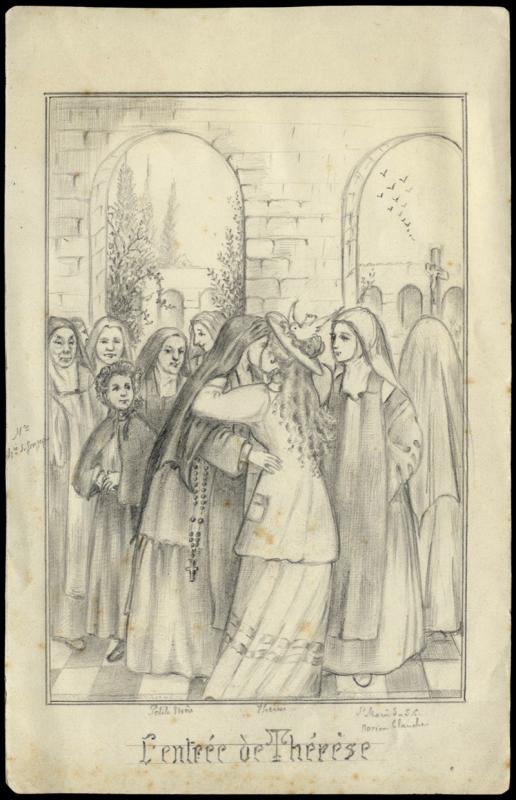
Léonie participates in Thérèse's entrance day, with sketches of St. Therese entering Lisieux Carmel on April 9, 1888 - from the Web site of the Archives of the Carmel of Lisieux

Léonie had returned from a six-month stay (her first) at the Visitation of Caen on January 6, 1888, so she was living with her father, Céline, and Thérèse at Les Buissonnets at this time.  She joined her family at Thérèse's farewell dinner there on April 8. Thérèse writes of that evening "My dear little Léonie, who had returned from the Visitation a few months previously, kissed and embraced me often."  When Léonie testified at the diocesan process for Thérèse's beatification in 1910, she spoke about Thérèse's entrance:

"I was present when my little sister left home for Carmel.  I did not enter the Visitation Order definitvely until 1899, but I had made two attempts: one, which lasted six months, in 1887, and another of about two years, in 1893.  So when Thérèse was bidding us farewell, I had returned from my first stay with them.  I found her strength of character particularly striking on this occasion; she was the only one of us who was calm.  Only her silent tears bore witness to the pain she felt at leaving father, whom she loved so much, and for whom she was the only consolation of his old age.

I told her to think well on it before entering a convent, that my own experience had taught me that such a life demanded many sacrifices of one, and was not to be entered into lightly.  Her answer and the expression on her face told me that she expected sacrifices and accepted them joyfully.  

At the entrance to the Carmelite enclosure, she knelt before our imcomparable father for his blessing, but, as far as I can remember, he was prepared to give it only on bended knees.  Only God can measure what a sacrifice he was making, but for that great and generous Christian to know the will of God and to do it were one and the same thing." 

from "St. Therese of Lisieux By Those Who Knew Her," edited and translated by Christopher O'Mahony.  Dublin: Veritas Publications, 1973.


After I published the photo essay of St. Therese entering Carmel, I discovered at the Web site of the Archives of the Carmel of Lisieux  the section "St. Therese's Life in Pictures" (103 documents, many never published before, depicting sixty scenes in Thérèse's life).  I post below several sketches of Thérèse's entrance  day. 

At the Archives site the images are a little bigger and are  accompanied by text from Thérèse and some details; to visit them there, please click on the images below

.

3-01-j-entree-au-carmel.jpg

The Martin and Guerin families approach the chapel of the Carmel on the day of Therese's entrance. By Charles Jouvenot.

aqua-entree-1.jpg

Therese has just stepped into the enclosure.  Her father is outside with Canon Delatroette.

3-02-dehors.jpg

Therese's first moments in the enclosure.  Unused sketch.

3-03-dedans.jpg

The young man who proposed marriage to Celine Martin, sister of St. Therese of Lisieux, on April 9, 1888

zceline-029.jpg

Celine Martin as a young woman

St. Therese entered the Carmelite monastery at Lisieux after the 7:00 a.m. Mass on Monday, April 9, 1888.  But that was not the only momentous event in the life of the Martin family that day.  That same evening Celine, Therese's eighteen-year-old sister, received an offer of marriage.

For more than a century the identity of Celine's first suitor remained unknown to the public.  The first young man ever known to have proposed marriage to any of the Martin daughters, he was a Man of Mystery.  I'd often wondered who he was and how he had become friends with the Martin family, who led a sheltered life at Lisieux.  In 1997, when Bishop Guy Gaucher, O.C.D., whose knowledge of every detail of the family's life is unparalleled, spoke at a Carmelite conference at Marquette University, I asked him for the name of the young man who proposed to Celine the night after Therese entered.  He answered "We don't know."  Since then, further research has identified the suitor, for both the Web site of the Archives of the Carmel of Lisieux and Bishop Gaucher's exhaustive 2010 biography, Sainte Therese de Lisieux (1873-1897), divulge the name: Albert Quesnel.

Quesnel_Albert-1.jpg

M. Albert Quesnel on March 27, 1893, almost five years after he asked Celine Martin to marry him

The Quesnel family, wealthy jewelers, were neighbors of the Martins.  Their house, near Les Buissonnets, was also located in the parish of Saint-Jacques.  Albert, their only son, was born July 16, 1858 at Lisieux, four days after the midnight wedding of Celine's parents, Louis and Zelie Martin, in Alencon on July 12, 1858.  His family were close friends of the Martins, and he had known St. Therese during her childhood and until she became a Carmelite.  He had given Celine advice in drawing and painting, in which he was gifted. 

At the time he asked Celine to marry him, Albert Quesnel was twenty-nine years old.  Although Celine did not seriously consider accepting him, his proposal upset her, making her question her religious vocation.  Years later she wrote in her autobiography:

This piece of news distressed me, not that I was undecided as to what I had to do, but the divine light, in hiding itself from me, delivered me up to my own fickleness; I kept telling myself "Isn't this offer, which is made to me the instant Therese leaves me, an indication of God's will for me, which I hadn't foreseen?"  The Lord may have permitted me this desire for religious life up until now so that, in the world, I might be a strong woman.  So many people tell me I do not have the makings of a religious!  Perhaps, indeed, I haven't been called to that life by Divine Providence.  My sisters never had to choose formally between the two lives; doubtless, God wanted them for himself, and he does not want me!  In short, although my resolution had never changed, my anguish kept mounting and mounting . . . . I could no longer see clearly. Yet, just in case, I responded that I was not willing, that I wanted to be left in peace for the time being, and that no one should wait for me. 

(Celine: Sister and Witness of St. Therese of the Child Jesus, by Stephane-Joseph Piat, OFM.  San Francisco: Ignatius Press, 1997, pp. 33-34).

Therese was not the only Martin daughter whose vocation was beset with trials! 

After Celine refused his proposal, M. Quesnel decided to study for the priesthood.  He continued to be friends with the Guerin family.  Mme. Guerin mentions him in a letter, and on March 27, 1893, he was photographed while attending a reception at the Guerin home.  See the group photograph at the Web site of the Archives of the Carmel of Lisieux.

Quesnel_Albert-2.jpg

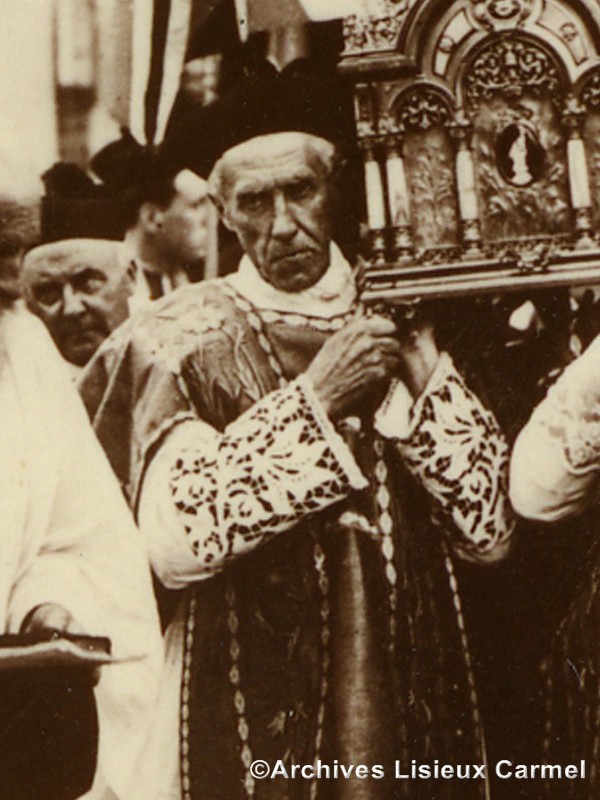
M. Quesnel carrying the reliquary of his former neighbor, little Therese Martin, who had become St. Therese of Lisieux

He was ordained, and he served as a parish priest in Ranville, where he  died on May 11, 1935, and where he is buried. Celine, who entered the Carmelite monastery in Lisieux on September 14, 1894, more than six years after his proposal, outlived him by  almost twenty-four years, dying on February 25, 1959.

Except the text from Celine cited to Piat, the information in this article is drawn from Bishop Gaucher's Sainte Therese de Lisieux (1873-1897) and from the Web site of the Archives of the Carmel of Lisieux. I thank the Archives for permission to display their photographs of M. Quesnel and of Celine.  To see many more photos and documents, visit the Archives Web site.

An essay illustrated with 19th century photos to celebrate the 125th annniversary of the day St. Therese of Lisieux entered Carmel, April 9, 1888

Therese Martin entered Carmel on Monday, April 9, 1888.  That year April 9 was the feast of the Annunciation, which had been transferred from March 25 because of Lent.  This photo essay is to celebrate the 125th anniversary of her entrance.

saint-therese-of-lisieux04.jpg

Therese a few days before she entered on April 9, 1888

Let's listen to some accounts of her entrance.  First, Saint Therese's own:

cour-Chapelle-ext-a-avant-1919.jpg

"On the morning of the great day, casting a last look upon Les Buissonnets, that beautiful cradle of my childhood which I was never to see again, I left on my dear King's arm to climb Mount Carmel. Chapel entrance of Lisieux Carmel photographed shortly after Therese's death

 As on the evening before, the whole family was reunited to hear Holy Mass and receive Communion.  As soon as Jesus descended into the hearts of my relatives, I heard nothing but sobs around me. 

Chapelle-sanctuaire-at-1919.jpg

 I was the only one who didn't shed any tears, but my heart was beating so violently it seemed impossible to walk when they signaled for me to come to the enclosure door.  I advanced, however, asking myself whether I was going to die because of the beating of my heart!  Ah! what a moment that was.  One would have to experience it to know what it is.

08martin58ans-1.jpg

Louis Martin, probably at age 58, about 1881

 My emotion was not noticed exteriorly.  After embracing all the members of the family, I knelt down before my matchless Father for his blessing, and to give it to me he placed himself upon his knees and blessed me, tears flowing down his cheeks.  It was a spectacle to make the angels smile, this spectacle of an old man presenting his child, still in the springtime of life, to the Lord!

cour-de-la-porte.jpg

Space where Louis knelt to bless Therese when she entered, April 9, 1888A few moments later, the doors of the holy ark closed upon me, and there I was received by the dear Sisters who embraced me.  Ah! they had acted as mothers to me in my childhood, and I was going to take them as models for my actions from now on.  My desires were at last accomplished, and my soul experienced a peace so sweet, so deep, it would be impossible to express it." 

(Story of a Soul: The Autobiography of St. Therese of LIsieux, tr. John Clarke, O.C.D.  Washington, D.C.: ICS Publications, 3rd ed., 1996.  Used with permission).

Delatroette-lt.jpg

Canon Delatroette

St. Therese writes "A few moments later."  She tactfully omits what other witnesses report happened in those few moments.  Canon Jean-Baptiste Delatroette, the parish priest of St. Jacques, was the ecclesiastical superior of the Lisieux Carmel (the priest charged with supervising, from the outside, this community of women religious).  He had bitterly opposed Therese's entrance, believing her too young, but was overruled by his bishop, who left the decision up to the prioress.  Before Therese crossed the threshold, and in the presence of her father and her sisters, Canon Delatroette announced "Well, my Revend Mothers, you can sing a Te Deum.  As the delegate of Monseigneur the bishop, I present to you this child of fifteen whose entrance you so much desired.  I trust that she will not disappoint your hopes, but I remind you that, if she does, the responsibility is yours, and yours alone."  He could not have foreseen that twenty-two years later Pope St. Pius X would call this girl "the greatest saint of modern times."

Much less well known than Saint Therese's account of her entrance is Celine's description of her experience of the same moment. Celine and Leonie were present with their father at the short ceremony. 

celine-et-leonie1889.jpg

Celine and Leonie the year after Therese enteredAfter writing of how inseparable she and Therese were, Celine continued:

It tookmuchyettoget toMonday, April 9, 1888, where the little Queen left her own, after we heard Mass together in the Carmel, to join her two older sisters in the cloister.  When I gave her a farewell kiss at the door of the monastery, I was faltering and had to support myself against the wall, and yet I did not cry, I wanted to give her to Jesus with all my heart, and He in turn clothed me in his strength.  Ah! how much I needed this divine strength!  At the moment when Thérèseentered theholy ark, the cloister door which shut between us was the faithful picture of what really happened, as a wall had arisen between our two lives."  (from the obituary circular of Celine Martin, Sister Genevieve of the Holy Face, copyright Lisieux Carmel; translation copyright Maureen O'Riordan 2013).

porte-conventuelle.jpg

The enclosure door which shut between Celine and Therese on April 9, 1888Saint Therese continues, writing of her impressions that first day:  "Everything thrilled me; I felt as though I was transported into a desert; our little cell, above all, filled me with joy."  St. Therese occupied three cells in Carmel, and until now few people have seen even a photograph of that first cell, for the photo commonly published was of Therese's last cell.  Thanks to the generosity of the Archives of the Lisieux Carmel, we can at last see early photos of the room Therese saw that day.  It was on the corridor near the garden:

1-cellule-porte.jpg

The corridor with the door to Therese's first cell standing openThis cell looked out on the roof of the "dressmaking building" where habits were made:

1-cellule-TH.jpg

Carmelite postulants wore a secular dress with a little capelet, and a small net bonnet on the head.  The photograph below of Marie Guerin as a postulant (she entered August 15, 1895) shows how St. Therese and all postulants dressed until they received the habit.

2e-cellule-TH-a-cote.jpg

Learn more about the Carmelite life Therese began to live on April 9, 1888.

The feast of the Annunciation is usually celebrated on March 25, just nine months before the feast of Christmas.  One of the other nuns testified that Therese loved the feast on March 25 "because that's when Jesus was smallest."  Therese began her Carmelite life on the feast of Mary's "Yes" to her Lord.  May each of us enter every day of our own lives with Therese's fervor and joy, for every day is a doorway for each of us to intimacy with God, to wholeness, and to sainthood.

Note: the Archives of the Carmel of Lisieux are being digitized and posted online in English at the Web site of the Archives of Carmel of Lisieux.  All the above photos are displayed courtesy of that site.  Please visit it here to see thousands of pages of photographs, documents, and information about St. Therese, her writings, her family, her environment, the nuns with whom she lived, and her influence in the world.  It is a true doorway to Saint Therese!


Film footage from the time of St. Therese of Lisieux of the arrival of a train in France


 This 52-second film, from the time of St. Therese, shows the actual arrival of a train at La Ciotat, near Marseilles.  Therese passed through it on her return from Rome to Lisieux in November 1887.  You can imagine that she was moving among people dressed in this way.  See more details of the pilgrimage to Rome at the Web site of the Archives of the Carmel of Lisieux.

The film "Leonie!" about the sister of St. Thérèse of Lisieux is now available on DVD

To purchase, click on the image

 The film "Leonie!," a feature film about the life of Léonie Martin, the sister of St. Thérèse of Lisieux, is now available for purchase as a DVD.  This 90-minute feature film was produced by Holy Trinity Productionsin Michigan as a labor of love.  It was filmed in the Midwest, and the scenes at the Visitation were shot in the Visitation Monastery of Toledo.  The energy of the young American actresses and actors may appeal particularly to children and young people.  "Leonie!" is not a documentary; it does not explore in depth Léonie's spirituality or her correspondence with Thérèse.  This film depicts with care the events of Léonie's life: her unhappy childhood, her three unsuccessful attempts at religious life, and her life at the Monastery of the Visitation of Caen, where she entered definitively in 1899 and died in 1941; her testimony at the inquiries for her sister's cause, and her reunion with her three Carmelite sisters when she testified at Lisieux for Therese's canonization. It enacts many amusing incidents from her life in the Visitation community at Caen.

framed face Leonie habit-2.jpg

Léonie was one of the first disciples of Thérèse's way of confidence and love.  A nun of the Visitation at Caen told me in 2008 that Léonie's superior, whom she knew, reported that Léonie was always so happy and at peace that it was almost impossible to believe that her early life had been so hard.  Léonie is very much loved by many people; her monastery receives many letters recounting the graces she obtains from God for those who seek her intercession.  She appeals especially to those who have been deeply wounded, to special children and their parents, and to those who, like her, struggle to find their place in the world.  Many pilgrims visit Caen to pray at her tomb.  I hope that the long-awaited distribution of the film Leonie! will stimulate viewers to learn more about Léonie's life and spirituality.  Note of February 8, 2015: the book Leonie Martin: A Difficult Life is now available as an e-book!  Click here to purchase  it). 


The anniversary of the death of Blessed Louis Martin on Sunday, July 29, 1894

louismartindeath.jpg

Blessed Louis Martin in death

The letter  from Celine Martin, at La Musse, near Evreux, to her Carmelite sisters in Lisieux to tell them about the death of their father:

July 29, 1894

Dear little sisters,

     Papa is in heaven! . . . I received his last breath, I closed his eyes. . . . His handsome face took on immediately an expression of beatitude, of such profound calm !  Tranquility was painted on his features . . . He expired so gently at fifteen minutes after eight.

     My poor heart was broken at the supreme moment; a flood of tears bathed his bed.  But at heart I was joyful because of his happiness, after the terrible martyrdom he endured and which we shared with him . . . .

     Last night, in a sleep filled with anguish, I suddenly awakened; I saw in the firmament a kind of luminous globe . . . . And this globe went deeply into the immensity of heaven.

. . . . . . . . . . .. . . . . . . . . . . . . . . . . . . . . .. . . . . . . . . . . . . . . . . . . . . .. . . . . . . . . . . . . . . . . . . . . .. . . . . . . .    Today, St. Martha, the saint of Bethany, the one who obtained the resurrection of Lazarus . . . .

     Today, the gospel of the five wise virgins.  . . .

     Today, Sunday, the Lord's day . . . .

     And Papa will remain with us until August 2, feast of Our Lady of the Angels.  . . .

Your little Celine

(from Letters of Saint Therese of Lisieux, Volume II.   Washington, D.C.: copyright 1988 by Washington Province of Discalced Carmelites, ICS Publications, pp. 874-875.  Used with permission).

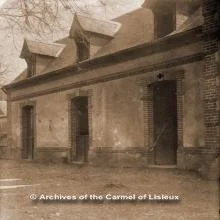
 Below, courtesy of the Web site of the Archives of the Carmel of Lisieux, is a photograph of the small building at La Musse in which Blessed Louis Martin died on that Sunday morning a hundred and eighteen years ago. 

mid_la-musse020-maison-lm-dcd_wm.jpg

"Louis and Zelie Martin: A marriage of love," by Guy Gaucher, O.C.D.

For the fourth feast of Blessed Louis and Zelie Martin on July 12, I highlight the article "Louis and Zelie Martin: a marriage of love," by Guy Gaucher, O.C.D.  To celebrate the feast, please visit the pages about their lives, their beatification, and their significance today.

beatifymedalfront.jpg

Louis and Zélie Martin: A marriage of love

 by Guy Gaucher, O.C.D., auxiliary bishop emeritus of Bayeux and Lisieux

published in French in Feu et Lumiere no. 230, July/August 2004.  You may now view the French text thanks to the Internet Archive.

translated by Susan Ehlert for thereseoflisieux.org

"I", said Zélie Martin, "love children to madness. I was born to have them." This home, however, might never have existed. Louis Martin, at age 20, was in Switzerland as an apprentice in watchmaking. He discovered the highest monastery in Europe, the Hermitage of the Great St. Bernard of the Canons Regular of Saint Augustine, helpers to mountain climbers during avalanches. The prior was firm: no knowledge of Latin, no postulancy in the monastery. Disappointed, Louis returned to the plain of Alençon and became a watchmaker.

For her part, Zélie Guérin, who wanted to be admitted to the Sisters of Saint Vincent de Paul of Alençon, met with the superior, who said she had no vocation.  Zélie decided then to go to lacemaking school to be initiated into the formidable art of precision of making Point d' Alençon lace, a "collective masterpiece."

In 1853, at twenty-two years of age, she established herself, with her sister Elise as a "manufacturer of Point d' Alençon," employing women who worked at home, then brought their work to her to assemble.  She had also to find clients, fill their orders, and keep her "office" in their house on the rue Saint-Blaise.

The watchmaker married the lacemaker on July 13, 1858 in the Church of Notre Dame at Alençon.  "They were married and had many children." Thus ended the tales that delighted us in childhood.

An idyllic tale?

One must read the letters of Zélie (there are 218 left) that were spread out from 1863 to 1877, the year of her death. Republished as a book, Correspondance Familiale, they follow the ordinary life of this family according to the rhythm of the births, the mourning periods, throughout the War of 1870, the economic crises, above all the family joys, but they end brutally with a drama: the death of Zélie, of cancer, at age forty-six, leaving Louis in charge of his five minor daughters: Marie, Pauline, Léonie, Céline, and Thérèse.

In fact, the nine children all had “Marie” for their first Christian name; they were distinguished by the name that followed. How could one be surprised that Therese might write of "the maternal preferences of heaven’s Queen for our family" (Ms. A, 2r).

After the death of Zélie, under the friendly urging of his brother-in-law, Isidore Guérin, a pharmacist living in the shadow of the Cathedral of Lisieux, Louis agreed to uproot himself from his friends and his environment for the good of his daughters. He moved to Lisieux, where their education was facilitated by the family friendship of the Guérin household, which itself had two girls, the cousins Jeanne and Marie. This is how there came to be a “Thérèse of Lisieux.”

An ordinary family....hardly ordinary

The Martins in Alençon? A family like others. Merchant craftsmen: a watchmaker who works alone, puts together and repairs watches for twenty-one years at 17 rue du Pont Neuf. He helps his wife with her business, she who unceasingly works her "Point d'Alencon."

The life of their family, which grows regularly, is one of their centers of attention. Their recreations, within the family, are simple.  Zélie and Louis lost four children because of infant mortality: Marie-Hélène, Marie-Joseph, Marie-Jean-Baptiste, Marie-Mélanie-Thérèse, a terrible reality in this 19th century.

What is less ordinary is the place that God holds in their personal and communal life.

Few parishioners of Notre Dame Church go every day to the 5:30 a.m. Mass, the "workers' Mass." In all things, God is first. The family prayer is twice daily, governed by the liturgy and the Angelus.  Christmas; Lent; Easter; May, the month of Mary; the feast of the Assumption on August 15th all have a central place in the family life.  The children are profoundly marked by this rhythm. Masses, Vespers, Compline, missions, often with very long sermons, bring the family together in church.

Louis Martin respects scrupulously not working on Sunday, preferring to lose all his clientele, and he respects the rigorous fasts the Church requires during Advent and Lent.

Zélie’s spirituality is marked by that of the Visitation Order, where her sister, who has become Sister Marie-Dosithée, entered in 1858. Zélie, who is a member of the Third Order of the Poor Clares, also has affinities with Saint Francis of Assisi.

From her childhood, which was not happy (her mother was very harsh), she kept her worry and fear to herself, as many people did during that epoch.  Her deeper life is union with God in the daily life of a mother of a family of five children, with the worry about Léonie, more difficult than the others; elderly parents; and young country maids who bring her worries more often than effective assistance.

Louis Martin had kept his sense of the inner life; of personal prayer; in fact, of contemplation; of his desire to be a monk. He loves pilgrimages and participates in several, including pilgrimages to Chartres, Lourdes, and Our Lady of Victories. 

His favorite pastime is fishing. He is also a good billiard player. He meets his Alençon friends at the Catholic Circle and participates in the nocturnal adoration of the Eucharist.

One might fear that such a household might not be much fun. According to the daughters who lived there, it wasn't like that at all. It had atmosphere, gaiety, games, celebrations, and family outings.

These Christians are not wrapped up in their piety. "If you do not love your sister or brother, whom you have seen, you cannot love God, whom you have not seen.”  (1 John 4:20)

They quietly live a concrete charity in which they engage themselves physically. Thus Zélie, in spite of her fears, will help two little girls terrorized by two women posing as nuns. She was obliged to testify at the police station. Louis welcomes an epileptic he met at the train station and helps to take care of him. They had the same concern for the homeless of their time.  They didn't hesitate to invite to their dinner table the tramps they met in the street. They visit the elderly and teach their children to honor the poor and to treat them as equals. Thérèse would be forever marked by this attitude.

A mother stricken

Louis and Zélie live a Passion, each in her or his own manner.  When, in December 1876, Zélie learns that she has an inoperable cancer that leaves her without hope, Louis is "overwhelmed;” panic takes over his household.

With a heroic courage, Zélie faces death, working until the limit of her strength, going to Mass each morning until the end. A pilgrimage to Lourdes, filled with deplorable incidents, will add still more to her sufferings. Her worry is the future of her five daughters. She worries above all for "poor Léonie," who, as Zélie knows, is more fragile than the other girls.  Zélie will leave her family on August 28, 1877.

A father humiliated

The passion of Louis will be of another kind. From November 1877 onward, he lived as a renter in the house of the Buissonnets, which he leased in Lisieux.  He accepted giving all his daughters in turn to God: Pauline (1882); Marie (1886); Léonie (who would make several tries in religious life and would finally become a Visitation nun in Caen in 1899); next his little Queen, Thérèse (1888). Céline enters the Carmel in 1894.

Louis’s shaky health deteriorated more and more until a serious attack made it necessary for him immediately to enter the Bon Sauveur asylum in Caen. Today we call it a psychiatric hospital, but in 1889 people called it the "insane asylum” instead.

Here is the venerable "Patriarch" in the middle of five hundred sick people of all kinds. He became number 14449. The man so esteemed and so respected sank into the worst kind of decline. He drank “the most bitter and most humiliating of all chalices," wrote Thérèse in Ms. A, 73r. Most of the doctors diagnosed him with cerebral arteriosclerosis and kidney failure. This is how the family broke apart. The lease of Les Buissonnets was terminated. Three of the daughters were Carmelites.

Unhealed, Louis Martin was returned to the Guérin family, who lodged him next door to their house in Lisieux, where Céline aided him night and day. He spends his vacations on the property of La Musse, which the Guérins inherited. He is like a child who perpetually asks for help. He dies on July 29, 1984, and is buried in the Lisieux cemetery.

In 1888, when the priest of St. Pierre’s Cathedral, Louis’s parish church, announced that he was starting a fundraising drive for a main altar, Louis donated the entire sum for the altar.  Thérèse commented, "Papa had just made a donation to God of an altar, and it was he who was chosen as victim to be offered with the Lamb without spot.”  (Ms A, 71v).

Re-reading the life of her family in the light of Merciful Love in 1895, Sister Thérèse of the Child Jesus wrote, evoking the day of her reception of the habit in Carmel where she was on the arm of her "dear King": "January 10 . . . was my King’s day of triumph.  I compare it to the entry of Jesus into Jerusalem on the day of the palms.  Like that of our Divine Master, Papa’s glory of a day was followed by a painful passion, and this passion was not his alone.  Just as the sufferings of Jesus pierced His Mother’s heart with a sword of sorrow, so our hearts experienced the sufferings of the one we cherished most tenderly on earth.  I recall that during the month of June 1888, at the moment of our first trials, I said," I am suffering very much, but I feel I can still bear greater trials." I was not thinking then of the ones reserved for me...I didn't know that on February 12, a month after my reception of the Habit, our dear Father would drink the most bitter, the most humiliating of all chalices.

Ah! that day, I didn't say I was able to suffer more!  Words cannot express our anguish, and I’m not going to attempt to describe it. One day, in Heaven, we shall love talking to one another about our glorious trials; don’t we already feel happy for having suffered them?  Yes, Papa's three years of martyrdom appear to me as the most lovable, the most fruitful of my life; I wouldn’t exchange them for all the ecstasies and revelations of the saints.  My heart overflows with gratitude when I think of this inestimable treasure that must cause a holy jealousy to the angels of the heavenly court...." (Ms A, 73r).

On July 26, 1897, very close to her death, Thérèse, herself living a physical and spiritual "passion,” wrote to Fr. Bellière a resume of the history of her family. She began thus: "The good God gave me a father and a mother more worthy of Heaven than of earth" (LT 261).

In 1888, shortly before Louis Martin fell ill, he wrote to his three Carmelite daughters, "I insist on telling you, my dear children, that I am urged to thank and to have you thank God, for I feel that our family, though very lowly, has the honor of being numbered among our Creator’s privileged ones.”  

A miracle for their beatification

A very serious investigation of the Martin parents has been conducted by the Church from 1967 until now. To declare them blessed a miracle was missing.  Here it is:

Little Pietro Schiliro, born at Monza on May 25, 2002 into a family of four children, was healed on June 28th, 2002, of a very serious and fatal pulmonary illness after two novenas to the Martin parents.

A Process was conducted in the diocese of Milan and came to a favorable conclusion.  Cardinal Tettamanzi closed it in Milan on June 10th, 2003. The medical dossier of the healed child numbers 967 pages!  [Editor's note: after this article was written, of course, the miracle was accepted, and Zelie and Louis were beatified on October 19, 2008).

The archives of the Carmelite Monastery of St. Therese of Lisieux online in English: read the authentic manuscripts of "Story of a Soul" on the Web

logo-archives-carmel-lisieux.png

The Carmelite monastery where St. Therese of Lisieux lived and died, which has digitized its magnificent archives and placed them on the Web for all to see,

has published its archives in English.

For the first time in history, the complete text of the English translation of the ICS Publications edition of

Story of a Soul,

St. Therese's classic memoir, is on the Web for all to read for free.  Read the

English translation of

Story of a Soul

here

.  This edition is the only published English translation made directly from Therese's original manuscripts.  All the English translations online before now were translations of inauthentic manuscripts, heavily edited and very different from the manuscripts as they left the pen of Therese.  Next to each typewritten page is the image of that page in Therese's handwriting.

StoryofaSoullarge.jpg

The hard copy of this edition, translated by Fr. John Clarke, O.C.D., contains many features not available online: an introduction and epilogue which put the manuscripts, written for her intimates, in context; a chronology; an index; a bibliography; and readable, informative footnotes.  If you do not own it, it is a most worthwhile purchase. 

Order Story of a Soul.

The resources of the English section of the Archives go far beyond

Story of a Soul.

From your own computer, you can see St. Therese's life and environment in its minutest detail: her handwritten manuscripts;  hundreds of photographs and documents rich in information about her milieu, her family, and her sister Carmelites; and much more. 

Visit the English section of the Lisieux Carmel Archives

.

Please return regularly; more than 30% of the site is now in English, and new English sections appear often.

Please join me in thanking and congratulating the Lisieux Carmel and the Washington Province of Discalced Carmelite Friars, together with their translators and collaborators and all who have contributed to create this extraordinary opportunity. May it create a global conversation about St. Therese which will draw many to Merciful Love.